
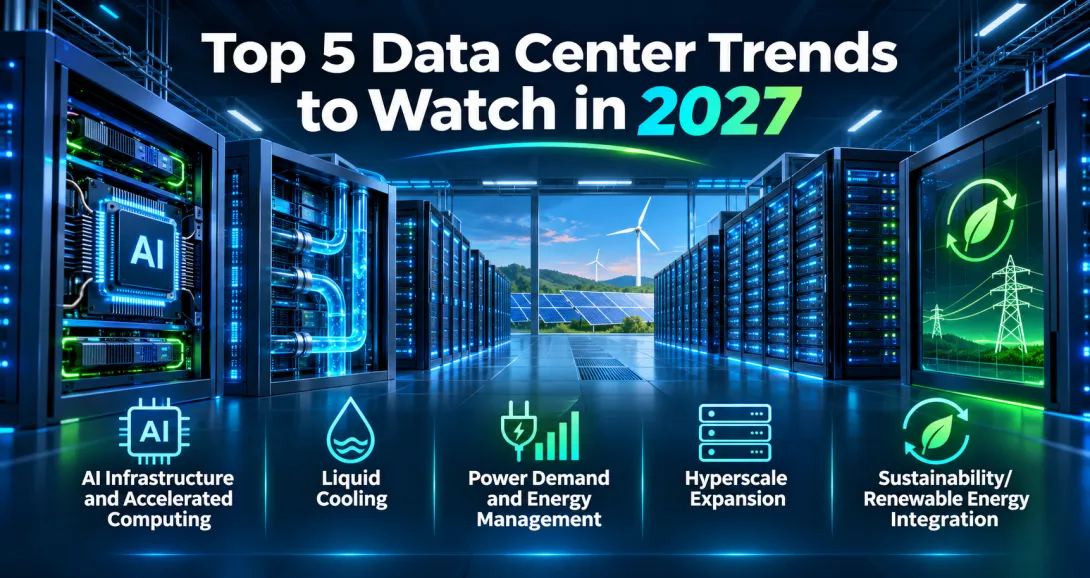
Top 5 Data Center Trends to Watch in 2027: AI Infrastructure, Liquid Cooling, Energy Storage and Intelligent Operations Set to Shape the Future
The global data center industry is preparing for significant changes in 2027 as artificial intelligence, cloud computing and digital services increase demand for high-performance infrastructure. Operators are reconsidering traditional facility designs to support more powerful processors, greater rack densities, advanced cooling requirements and increasingly complex electricity needs.
Recent developments highlight the scale of these challenges. The International Energy Agency (IEA) reported in April 2026 that global data center electricity consumption increased by 17% in 2025, substantially exceeding the approximately 3% growth recorded in overall worldwide electricity demand. The agency also projected that global data center electricity consumption could double by 2030, while electricity use from AI-focused facilities could triple over the same period.
Meanwhile, the Uptime Institute's 2026 Global Data Center Survey, released in July, identified electricity availability, rising operating costs, supply chain constraints and increasing rack power densities as major challenges facing infrastructure operators. These developments indicate that data centers are becoming more than facilities for storing information and hosting applications.
They are increasingly important infrastructure supporting artificial intelligence, industrial automation, digital communications and essential business services. Looking ahead to 2027, five data center trends are expected to influence infrastructure investment, technology development and operational priorities.
Top 5 Data Center Trends to Watch in 2027
1. AI-Ready Data Centers and High-Density Computing: From Traditional Server Rooms to AI Infrastructure
Artificial intelligence is changing the physical design and technical requirements of modern data centers. Traditional enterprise facilities were primarily designed to support general-purpose computing, business applications and data storage. In comparison, AI training and inference workloads require powerful accelerators, high-speed networking, advanced memory systems and significantly greater computing capacity.
The Uptime Institute reported in its July 2026 industry survey that a growing number of data center operators were recording peak rack power densities of 30 kilowatts or higher. This reflects increasing infrastructure requirements for advanced computing applications.
A major technological development was announced by NVIDIA in March 2026 with the introduction of its Vera Rubin computing platform, designed for large-scale AI infrastructure. The company's Vera Rubin NVL72 rack architecture integrates 72 Rubin GPUs and 36 Vera CPUs, demonstrating the increasing integration of processors, networking technologies and supporting infrastructure within high-density computing systems.
In 2027, AI-ready data centers are expected to receive greater attention as organizations expand generative AI, agentic AI, machine learning and large-scale inference applications. Facility operators will need to consider higher-capacity electrical distribution, liquid cooling compatibility, improved network connectivity and infrastructure designed to accommodate increasingly demanding computing systems.
The transition will also influence data center construction and modernization. Existing facilities may require significant upgrades before they can support high-density AI infrastructure, while new developments may increasingly incorporate AI requirements during the initial design stage. However, the pace of adoption will vary according to electricity availability, customer demand, capital requirements and the ability to secure specialized hardware.
Why it matters: AI-ready infrastructure is becoming an important requirement for advanced computing. In 2027, data center competitiveness will increasingly depend on the ability to deliver reliable processing capacity while managing electricity consumption, cooling performance and infrastructure costs.
2. Data Center Power Infrastructure and Battery Energy Storage: Electricity Availability Becomes a Strategic Priority
Power availability is emerging as one of the most important considerations in data center development. Increasing electricity consumption is placing additional pressure on utility networks, particularly in locations experiencing rapid growth in AI infrastructure and hyperscale computing facilities.
The International Energy Agency's April 2026 assessment revealed that electricity demand from data centers increased by 17% in 2025. The agency also reported that five major technology companies spent more than USD 400 billion in combined capital expenditure during 2025, with spending expected to increase by approximately 75% in 2026.
The rapid expansion of computing infrastructure is creating challenges involving grid connection delays, electricity generation capacity and equipment availability. As a result, data center developers are examining a wider range of energy strategies, including renewable electricity procurement, dedicated power generation, battery energy storage and more flexible interaction with electricity grids.
Battery energy storage systems are becoming particularly relevant for AI data centers because advanced computing workloads can produce rapid changes in electricity demand. Energy storage can help manage short-term power fluctuations, support backup requirements and improve the coordination of facility demand with electricity supply. In 2027, data center operators are expected to place greater emphasis on grid interconnection planning, high-capacity power distribution, battery storage integration and electricity management systems.
Interest in alternative energy sources, including advanced geothermal systems and nuclear power technologies, may also continue. However, the commercial availability, construction timelines and regulatory requirements of different energy sources will influence deployment decisions.
Why it matters: Access to reliable electricity is becoming a determining factor in data center expansion. In 2027, power availability, energy infrastructure investment and grid connection timelines could have a greater influence on site selection and project development.
3. Liquid Cooling and Sustainable Data Centers: Managing Heat, Water and Energy Efficiency
Cooling technology is undergoing significant changes as high-performance AI processors generate greater concentrations of heat. Traditional air-cooling systems remain suitable for many existing computing environments, but increasingly dense server configurations are creating demand for more advanced thermal management. Liquid cooling transfers heat using liquid-based systems and can provide more direct cooling for high-performance processors.
Technologies receiving growing attention include direct-to-chip liquid cooling, immersion cooling, closed-loop cooling systems and hybrid cooling architectures. Microsoft disclosed in June 2026 that approximately 90% of its owned data center fleet in 2025 used highly efficient cooling systems requiring little or no water for cooling.
The company also highlighted its newer AI data center design, which uses closed-loop, direct-to-chip cooling and avoids water evaporation during cooling operations. Another important development was reported by Google in its 2026 Environmental Report. The company disclosed that its water stewardship activities replenished approximately 7.7 billion gallons of water during 2025, equivalent to about 78% of its total freshwater consumption.
Google also reported that its global data center fleet achieved an average power usage effectiveness of 1.09 in 2025. Power usage effectiveness, commonly known as PUE, measures the ratio of total facility electricity consumption to the electricity used by computing equipment. A value closer to 1.0 generally indicates lower energy overhead for facility systems. In 2027, operators are expected to evaluate cooling technologies based on a combination of energy efficiency, water consumption, installation costs and suitability for local environmental conditions.
Heat reuse, alternative water sources and improved environmental reporting may also become more important as communities and regulators examine the resource requirements of large data centers. However, cooling decisions will involve trade-offs. Systems designed to reduce water consumption may require additional electricity under certain operating conditions.
Why it matters: Sustainable data center design increasingly requires a balance between computing performance, electricity efficiency and responsible water management. Advanced cooling will be important for supporting higher rack densities while reducing unnecessary resource consumption.
4. AI-Driven Data Center Operations and Digital Twins: From Manual Monitoring to Predictive Infrastructure Management
Data center operations are becoming more complex as facilities incorporate advanced computing systems, high-capacity electrical equipment and different cooling technologies. Managing this infrastructure requires continuous monitoring of temperature, electricity consumption, equipment conditions and operational performance. Artificial intelligence and digital twin technologies are creating opportunities to improve these activities.
A digital twin is a virtual representation of a physical system that can use operational information to support monitoring, simulation and performance analysis. The Uptime Institute's 2026 Global Data Center Survey found that operators expressed greater confidence in lower-risk applications of artificial intelligence, particularly sensor data analysis and predictive maintenance, than in fully autonomous facility control.
The survey also found that more than half of respondents experienced difficulties recruiting qualified professionals for open positions. These findings suggest that data center operators are interested in technology that can support existing teams while maintaining appropriate human oversight.
In 2027, AI-assisted infrastructure management is expected to advance through predictive equipment maintenance, automated anomaly detection, cooling optimization and more accurate capacity planning. Digital twins may also help operators assess potential infrastructure changes before implementation, including modifications to electrical distribution, cooling performance and equipment placement.
Another important application involves identifying early signs of equipment deterioration. By analyzing sensor readings and operating conditions, predictive systems may help maintenance teams recognize potential problems before they cause service interruptions. However, the effectiveness of these technologies will depend on reliable sensor data, system integration and appropriate operational controls.
Why it matters: Intelligent data center operations can improve equipment visibility, support maintenance planning and help organizations manage increasingly complex facilities. In 2027, practical automation and predictive analytics are expected to become important tools for maintaining infrastructure performance and reliability.
5. Data Center Resilience and Sovereign AI Infrastructure: Security, Reliability and Data Control Gain Importance
Data centers support critical digital services, making infrastructure security, operational continuity and reliable access to information increasingly important. As organizations depend more heavily on cloud computing and AI services, interruptions involving electricity, networking equipment or external service providers can affect business operations across multiple locations.
The Uptime Institute's Annual Outage Analysis 2026, published in May, reported that 57% of respondents to its 2025 survey said their most recent major outage had cost more than USD 100,000. The analysis also found that approximately one in five respondents reported outage costs exceeding USD 1 million. Although outage frequency has generally declined, the financial consequences of major incidents remain significant.
In 2027, infrastructure resilience is expected to receive greater attention as operators introduce increasingly complex computing, power and networking systems. Important priorities will include redundant power infrastructure, advanced monitoring, disaster recovery planning, physical security and cybersecurity protection for operational technology. Another significant development involves sovereign AI infrastructure.
Digital sovereignty refers to the ability of governments and organizations to maintain appropriate control over digital infrastructure, information processing and technology operations under relevant legal and regulatory requirements. The European Commission announced a proposal for the Cloud and AI Development Act in June 2026, with the objective of at least tripling European Union data center capacity over the following five to seven years.
The proposal also emphasizes energy-efficient infrastructure, secure cloud services and stronger European capabilities in AI computing. In 2027, interest in sovereign cloud and AI infrastructure is expected to increase among governments, financial institutions, healthcare organizations and other sectors handling sensitive information. Operators will need to consider data residency, jurisdictional requirements, access controls, infrastructure resilience and the security of connected systems.
Why it matters: Reliable and secure data center infrastructure is essential for business continuity and public trust. In 2027, resilience, regulatory compliance and control over sensitive information will influence infrastructure development and technology purchasing decisions.
What These Data Center Trends Mean for Businesses in 2027
The five trends highlight an important change in how data center infrastructure is planned and managed. Artificial intelligence is increasing demand for advanced computing, but the availability of electricity, cooling capacity and reliable operational systems is becoming equally important. For data center developers and operators, this means infrastructure decisions can no longer be based primarily on available land, construction costs and traditional IT requirements.
Power connection capacity, cooling technology, environmental conditions, equipment supply chains and regulatory requirements will increasingly influence development strategies. Enterprises purchasing cloud and colocation services will also need to consider infrastructure resilience, data protection and the ability of service providers to support future computing demands.
The interaction between these factors will create opportunities for specialized technology providers offering electrical infrastructure, liquid cooling equipment, battery energy storage, monitoring software and security systems. However, new technologies will require careful evaluation to determine whether they offer practical improvements in energy consumption, operational reliability and overall costs.
Data Center Outlook for 2027
The global data center industry is expected to continue expanding its role as critical infrastructure supporting artificial intelligence, cloud computing and connected digital services. Growing computing requirements will encourage investment in high-density server architectures, advanced cooling, reliable electricity supplies and intelligent facility management technologies. At the same time, energy availability, environmental considerations and infrastructure costs will influence the speed and location of future developments.
In 2027, successful data center strategies will increasingly depend on balancing computing performance with power efficiency, operational resilience and long-term sustainability. Organizations that carefully plan electrical capacity, cooling systems, automation and security requirements will be better positioned to support changing technology demands while maintaining reliable digital services.
Sources:
- https://uptimeinstitute.com/about-ui/press-releases/16th-annual-2026-gl…
- https://www.iea.org/news/data-centre-electricity-use-surged-in-2025-eve…
- https://nvidianews.nvidia.com/news/nvidia-vera-rubin-platform
- https://sustainability.google/google-2026-environmental-report/
- https://digital-strategy.ec.europa.eu/en/policies/cloud-computing
- Log in to post comments