

AI Agents vs Agentic AI: Detailed Market and Technology Analysis
AI agents and Agentic AI are closely connected, but they are not the same. An AI agent is usually a software system that can complete a defined task for a user by using reasoning, memory, planning, and external tools. Agentic AI is broader. It refers to a coordinated AI system that can plan, decide, act, monitor results, and adjust its actions with limited human supervision. In simple terms, AI agents are the working units, while Agentic AI is the operating system that coordinates one or many agents to complete larger business goals.
IBM and Google Cloud both describe AI agents as autonomous task-performing systems, while Agentic AI is positioned as a higher-level system focused on goal execution and orchestration. The difference is important because many companies are already using AI assistants or task agents, but fewer have built true Agentic AI workflows. In 2025, organizational AI adoption reached 88%, up from 78% in 2024, and generative AI use reached 79% across at least one business function. However, AI agent deployment remained early, with scaled use still in single digits across most business functions.
AI Agents Market Size
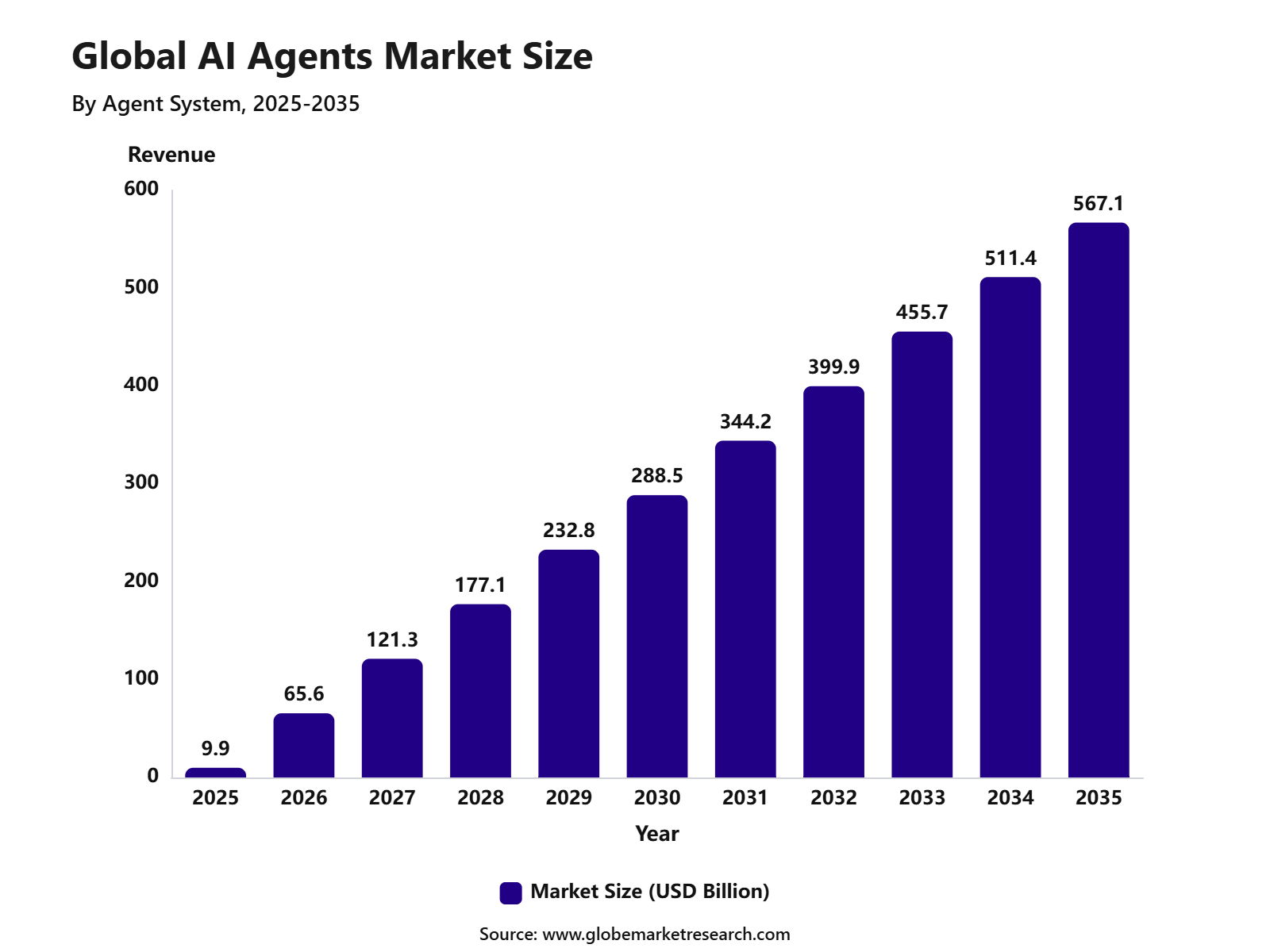
According to Globe Market Research (GMR), The global AI agents market was valued at USD 9.9 billion in 2025 and is projected to reach USD 567.1 billion by 2035, expanding at a CAGR of 49.9%. Growth is being supported by rising enterprise automation, wider use of AI assistants, and increasing demand for systems that can complete tasks with limited human input.
Market Highlights
Single agent systems led the market with 65.3% share in 2025, supported by easier deployment, focused task handling, and lower integration complexity.
Ready-to-deploy agents accounted for 69.7% share in 2025, as enterprises preferred faster implementation, pre-built use cases, and reduced development effort.
Productivity and personal assistants held 31.6% share in 2025, driven by growing use in task management, email support, scheduling, document processing, and workflow automation.
Enterprises dominated the end-use segment with 68.1% share in 2025, supported by rising adoption of AI agents to improve efficiency, reduce manual work, and support faster business decisions.
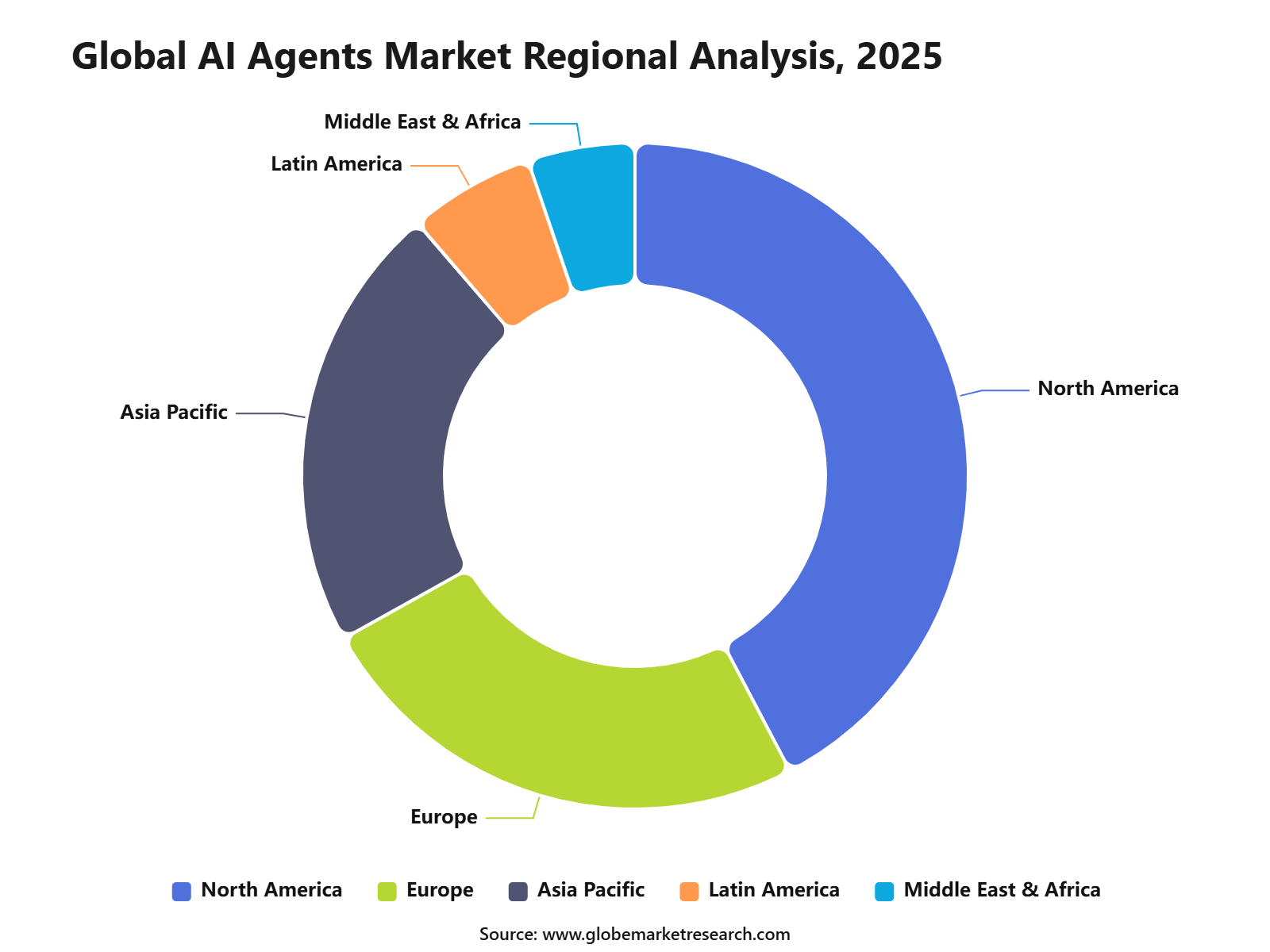
North America led the AI agents market with 42.3% share in 2025, supported by strong AI investment, cloud adoption, advanced digital infrastructure, and early enterprise automation.
The U.S. AI agents market reached USD 2.7 billion in 2025 and is projected to grow at a CAGR of 43.2%, driven by strong enterprise AI adoption and expanding automation use cases.
AI Agents Market Statistics
According to IBM, AI-enabled workflows are expected to rise from 3% currently to 25% by the end of 2025, indicating faster adoption of intelligent automation across business functions.
Around 64% of AI budgets are being directed toward core business functions, showing that AI agents are moving beyond pilots and becoming part of everyday operations.
Nearly 69% of executives identify better decision-making as the leading benefit of agentic AI systems.
About 83% of executives expect AI agents to improve process efficiency and business output by 2026.
Around 71% of executives believe AI agents will be able to adjust independently to workflow changes, strengthening their role in adaptive enterprise automation.
Agentic AI Market Size
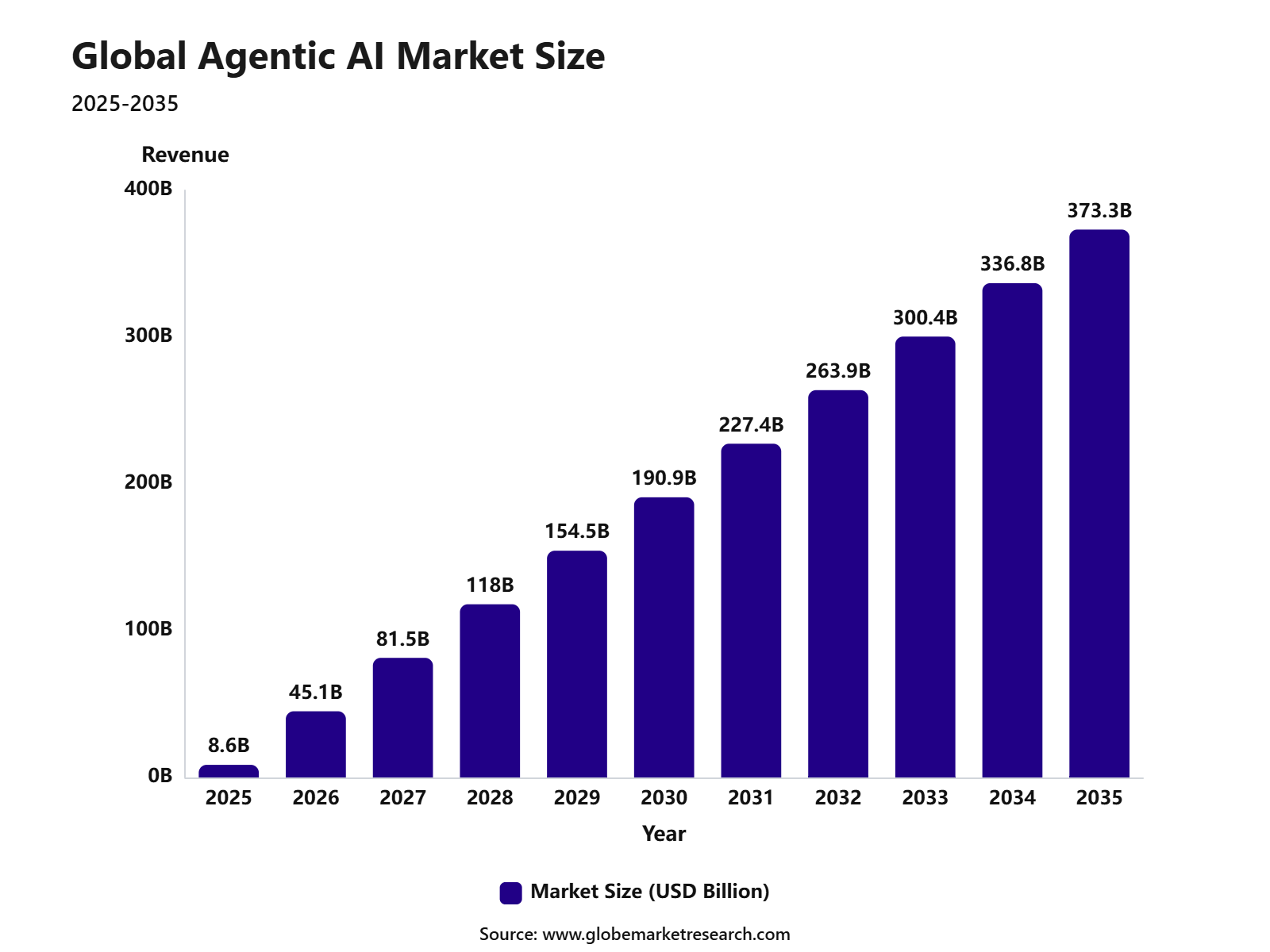
The global agentic AI market was valued at USD 8.6 billion in 2025 and is projected to reach USD 373.3 billion by 2035, growing at a CAGR of 45.8% during the forecast period. Growth is being supported by rising enterprise demand for autonomous AI systems that can plan tasks, make decisions, automate workflows, and improve business efficiency.
Market Highlights
- Solutions held 64.5% share of the agentic AI market, supported by strong demand for AI platforms, workflow automation tools, intelligent assistants, and decision-support applications.
- Cloud deployment accounted for 61.7% share, driven by faster implementation, flexible scaling, lower infrastructure requirements, and easier integration with enterprise systems.
- Large enterprises captured 67.3% share, as these organizations have stronger budgets, advanced digital infrastructure, and broader use cases for agentic AI across departments.
- BFSI represented 32.3% share by end-use industry, supported by growing adoption in fraud monitoring, risk assessment, customer service, compliance, and process automation.
- Multi-agent systems held 55.30% share, driven by their ability to manage complex workflows where multiple AI agents coordinate tasks and support decision-making.
- Autonomous process automation accounted for 24.5% share by application, supported by increasing enterprise focus on reducing manual work, improving speed, and strengthening operational efficiency.
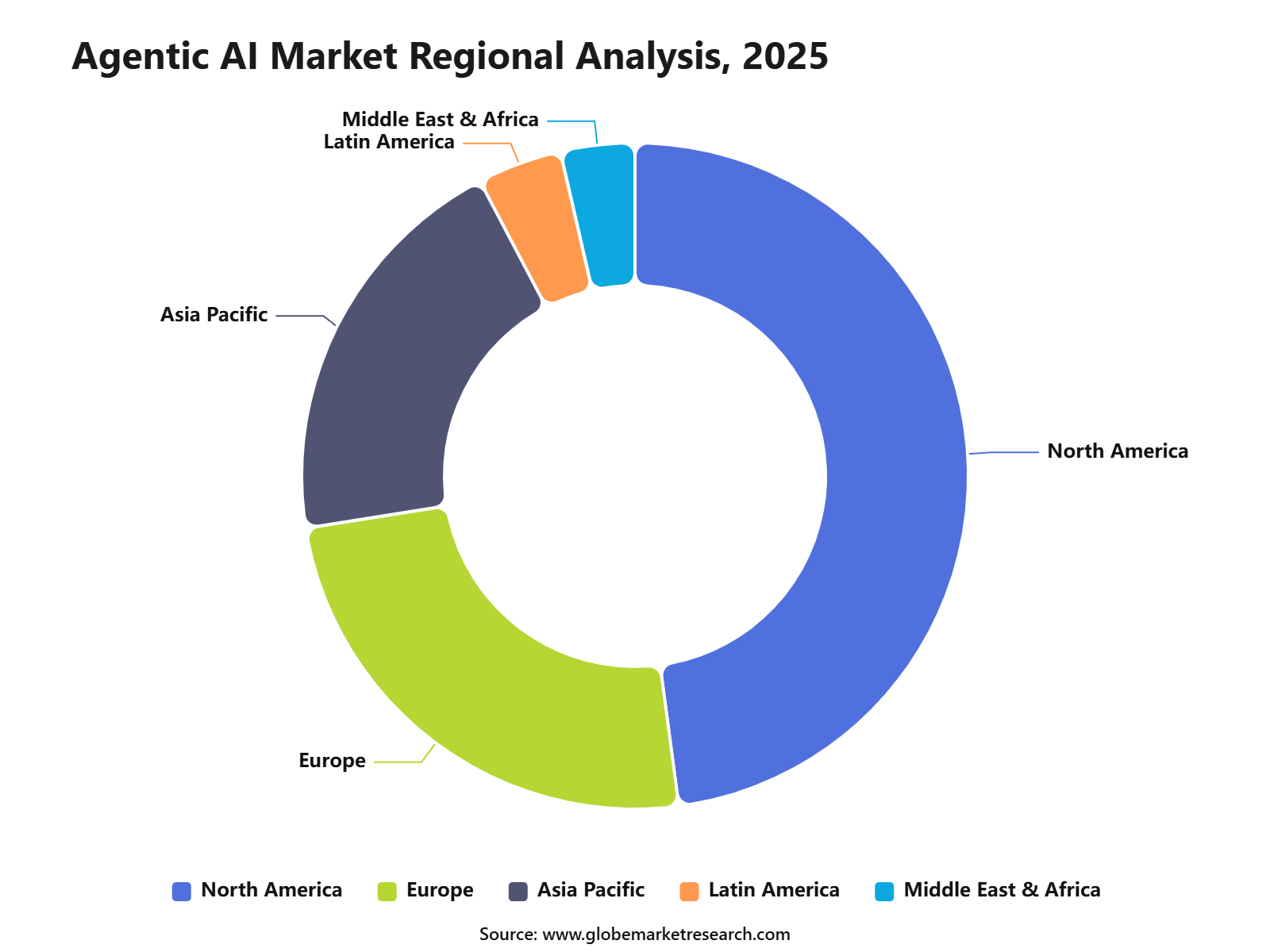
- North America led the agentic AI market with 47.9% share in 2025, supported by strong AI investment, advanced cloud infrastructure, skilled technology talent, and early enterprise adoption.
- The U.S. agentic AI market was valued at USD 3.1 billion in 2025 and is projected to grow at a CAGR of 45.1%, driven by strong demand for automation, AI-enabled productivity tools, and enterprise-grade intelligent systems.
Comparison Table
| Aspect | AI Agents | Agentic AI |
|---|---|---|
| Basic meaning | A software agent that performs a specific task on behalf of a user or system. | A broader AI system that coordinates agents, tools, data, and workflows to achieve larger goals. |
| Scope | Narrow to medium task scope. | Wider process or enterprise-level scope. |
| Autonomy level | Can act with some independence but usually within a defined task boundary. | Higher autonomy with planning, action, feedback, and self-correction across steps. |
| Main function | Execute tasks such as answering queries, writing code, summarizing documents, checking data, or updating records. | Manage complex workflows such as customer service resolution, supply chain planning, financial review, research automation, or multi-step operations. |
| Architecture | Often one agent linked to one or more tools. | Often multi-agent, multi-tool, and workflow-based orchestration. |
| Human role | Human gives the task and reviews the output. | Human sets goals, rules, guardrails, and approval points. |
| Memory use | May use short-term memory or task-specific context. | Often uses persistent memory, workflow history, business rules, and feedback loops. |
| Tool use | Uses tools such as search, databases, APIs, CRMs, coding tools, or spreadsheets. | Coordinates many tools and agents across business systems. |
| Best fit | Repetitive knowledge work, support tasks, coding help, research, reporting, and admin work. | Cross-functional automation, decision support, enterprise workflows, operations planning, and adaptive process management. |
| Risk level | Moderate, mainly linked to accuracy, data use, hallucination, and tool misuse. | Higher, because actions may affect multiple systems, decisions, customers, or compliance areas. |
| Business maturity | Already being adopted widely in task-level use cases. | Still early in scaled enterprise deployment. |
| Success measure | Time saved, task completion, accuracy, productivity, user satisfaction. | Business outcome, process speed, decision quality, cost reduction, risk control, and workflow scalability. |
Key Statistics
| Statistic | What it indicates |
|---|---|
| 88% of surveyed organizations used AI in at least one business function in 2025. | AI adoption has become broad across enterprises. |
| 79% of surveyed organizations regularly used generative AI in at least one business function in 2025. | Generative AI is now a base layer for many AI agent workflows. |
| Scaled AI agent use remained in single digits across nearly all business functions in 2025. | Most organizations are still in experimentation or pilot stages. |
| In the technology sector, scaled agent use reached 24% in software engineering, 22% in IT, and 21% in service operations. | Technical functions are leading early enterprise agent deployment. |
| 79% of surveyed senior executives said AI agents were already being adopted in their companies. | AI agents are moving from discussion to implementation. |
| 66% of companies adopting AI agents reported measurable productivity value. | Productivity remains the strongest early return area. |
| 57% reported cost savings, 55% reported faster decision-making, and 54% reported improved customer experience from AI agents. | Agent value is expanding beyond simple time savings. |
| 96% of enterprise respondents planned to expand AI agent use in the next 12 months. | Investment intent remains strong despite early-stage maturity. |
| Active agents in one large productivity ecosystem grew 15x year over year, and 18x in large enterprises. | Usage signals show rapid scaling inside enterprise software environments. |
| By 2028, 33% of enterprise software applications are expected to include Agentic AI, up from less than 1% in 2024. | Agentic functions are expected to become embedded in enterprise software. |
| More than 40% of Agentic AI projects may be canceled by the end of 2027 due to unclear value, cost, or weak implementation discipline. | Governance, ROI, and workflow design will be critical for success. |
What Are AI Agents?
AI agents are task-oriented systems that use AI models, instructions, tools, and data to complete work. They can read user requests, break down tasks, call tools, retrieve information, generate outputs, and sometimes take action in business systems. For example, an AI sales agent may search customer data, draft a follow-up email, update a CRM record, and prepare a meeting summary.
The main value of AI agents is productivity. They reduce manual effort in repetitive or information-heavy tasks. This is why early adoption is strong in IT, software engineering, customer support, marketing, sales operations, HR, and knowledge management. Their role is usually limited by permissions, workflow rules, and human review.
What Is Agentic AI?
Agentic AI is a more advanced structure where AI agents are coordinated to achieve a larger goal. It can plan steps, assign work to different agents, use multiple tools, monitor progress, learn from outcomes, and adjust its actions. This makes it useful for complex workflows where one task depends on another.
For example, a single AI agent may summarize a customer complaint. An Agentic AI system may classify the complaint, check purchase history, review warranty terms, suggest a resolution, draft a response, update the support ticket, alert a supervisor if risk is high, and learn from the final outcome. This wider workflow is what separates Agentic AI from a simple agent.
Business Impact Analysis
AI agents are mainly improving individual and team productivity today. They are helping employees complete tasks faster, reduce repetitive work, and access information more easily. Survey evidence shows that companies adopting AI agents are already reporting productivity gains, cost savings, faster decisions, and better customer experience.
Agentic AI is expected to create deeper business impact because it can redesign how work is done. Instead of adding AI to one task, organizations can rebuild entire workflows around human supervision and AI execution. This can improve process speed, reduce handoff delays, support real-time decision-making, and create more consistent operating standards across departments.
Where AI Agents Are Used?
AI agents are most useful where tasks are clear, repeatable, and data-driven. Common use cases include customer support chat, ticket routing, code generation, document review, meeting summaries, research support, invoice checking, lead qualification, and employee helpdesks. These applications usually have lower risk because the agent works inside a defined process.
Adoption is also rising in technical functions. Stanford’s 2026 AI Index reported higher scaled agent use in technology-sector software engineering, IT, and service operations than in most other areas. This reflects the strong fit between agents and structured digital workflows.
Where Agentic AI Is Used?
Agentic AI is better suited for processes that need coordination across departments, systems, and decisions. Examples include end-to-end customer service resolution, supply chain exception handling, financial risk review, automated research workflows, cybersecurity incident response, product development support, and enterprise knowledge operations.
Google Cloud identifies customer service, supply chain management, healthcare, financial services, and software development as major areas where Agentic AI can automate tasks and optimize workflows. These sectors benefit because Agentic AI can connect data, tools, rules, and decisions into one operating flow.
Key Benefits
The main benefit of AI agents is faster task execution. Employees can use them to reduce time spent on research, drafting, documentation, coding, reporting, and administrative work. This supports better productivity without immediately changing the whole operating model.
The main benefit of Agentic AI is workflow transformation. It can reduce manual handoffs, improve decision consistency, and allow teams to manage larger workloads with the same resources. For enterprises, the highest value will be seen where Agentic AI is linked to measurable outcomes such as lower support cost, faster resolution, shorter development cycles, better compliance checks, and improved customer experience.
Key Risks and Challenges
The biggest challenge for AI agents is reliability. Agents can misunderstand instructions, use incorrect data, generate inaccurate outputs, or call the wrong tool. These risks increase when the agent has access to business systems, private data, or customer-facing workflows.
Agentic AI adds another layer of risk because it can operate across multiple systems and make multi-step decisions. NIST has warned that many AI agents are vulnerable to agent hijacking, where malicious instructions are inserted into data that an agent may read, causing unintended or harmful actions. The 2025 AI Agent Index also found that safety and transparency disclosures remain limited across major agentic systems, with many safety-related fields lacking public information.
Governance Requirements
AI agents require clear rules, tool permissions, data access controls, testing, and human review. Companies should define what the agent can do, what it cannot do, and when human approval is required. This is especially important for customer communication, payments, legal review, HR decisions, and regulated data.
Agentic AI needs stronger governance because it works across wider workflows. Enterprises need audit trails, access management, model monitoring, fallback rules, human-in-the-loop approval, and incident response plans. Without these controls, the system may scale errors faster than humans can detect them.
Final Interpretation
AI agents are the practical entry point for enterprise AI automation. They are already being adopted for task-level productivity and are showing measurable value in areas such as software engineering, IT, customer support, research, and business operations.
Agentic AI is the next level of AI maturity. It moves beyond single-task assistance and focuses on coordinated action across full workflows. The opportunity is significant, but the success of Agentic AI will depend on clear use cases, strong governance, reliable data, secure tool access, and measurable business value. Organizations that treat Agentic AI as a controlled operating model, not just another AI feature, are more likely to achieve sustainable results.
- Log in to post comments