
Introduction
AI Receptionist Statistics: AI receptionists are moving beyond basic call-routing systems to become intelligent voice assistants capable of handling everyday customer interactions. In 2026, these systems can answer incoming calls, respond to common questions, capture customer information, qualify leads, schedule appointments, transfer calls, and manage after-hours inquiries. More advanced solutions can also connect with calendars, customer relationship management (CRM) software, and business applications to complete tasks during conversations.
The importance of faster call handling is supported by recent consumer behavior. A 2025 survey of 1,000 U.S. consumers found that 78% had abandoned a business after an unanswered phone call. Businesses are increasingly using AI receptionists to reduce missed inquiries, maintain customer availability, and support employees during busy periods.
After-hours communication is another important application. An analysis of U.S. small-business calls collected between October 2025 and September 2026 found that 14.1% of incoming calls occurred outside normal business hours. These calls included potential customers seeking information, requesting services, and making appointments when employees were unavailable.
Customer acceptance is improving, although human assistance remains important. A 2026 survey involving 3,566 business and consumer customers found that 87% considered access to a human representative essential when companies use generative AI for customer service. This suggests that effective AI receptionists should combine automated responses with reliable human call transfers.
The latest AI receptionist statistics for 2026 highlight changes in customer expectations, automated appointment booking, after-hours call management, business adoption, and the growing importance of AI-assisted customer communication.
Top 10 AI Receptionist Statistics 2026
- More than 11,800 businesses were using one commercially deployed AI receptionist platform by May 2026, showing that voice-agent reception has moved beyond small pilots.
- 43% of U.S. consumers said they were comfortable with a small business using an AI receptionist.
- 80% of consumers wanted the AI to disclose that it was an AI at the beginning of the call.
- 78% of consumers said they had purchased from or hired a competitor at some point because a business failed to answer or return their call.
- 14.1% of small-business calls in a 2026 operational dataset arrived outside standard business hours.
- 23.6% of those after-hours calls became a lead or booking, indicating that out-of-hours calls can carry substantial commercial value.
- One large-scale AI voice deployment is now handling approximately 20,000 customer-support calls per day.
- Roughly 70% of those calls are resolved without human involvement, demonstrating how far voice automation has progressed for structured support workflows.
- 74% of surveyed consumers said AI-powered voice could significantly improve their overall customer experience.
- Voice still represents around 40% of contact-center interactions, meaning phone automation remains commercially relevant even as chat and messaging expand.
AI Receptionist Market Size Statistics
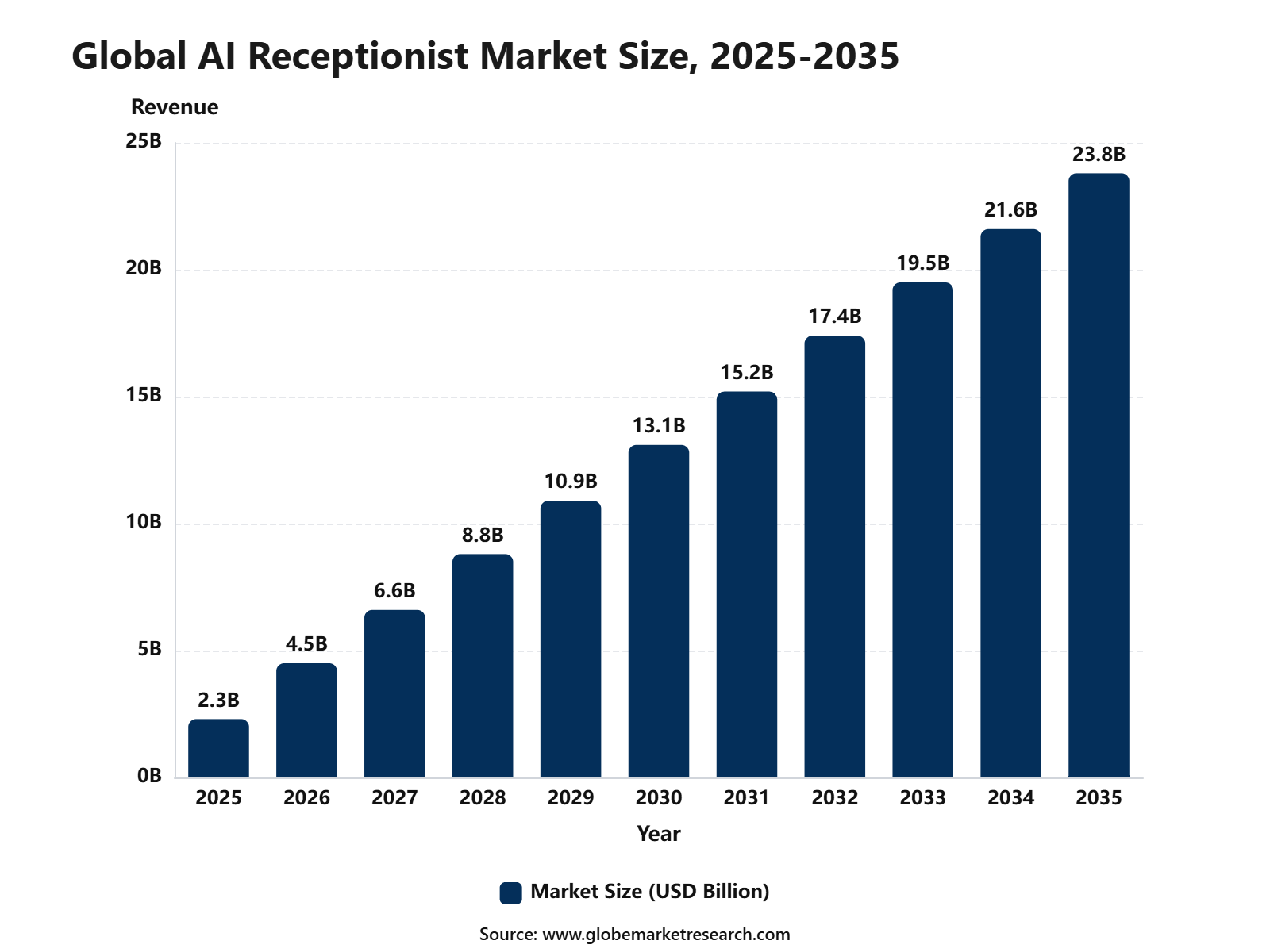
The global AI receptionist market was valued at USD 2.3 billion in 2025 and is projected to reach USD 23.8 billion by 2035, expanding at a CAGR of 26.3% during the forecast period. This growth reflects increasing business demand for automated customer communication, 24/7 call availability, appointment scheduling, and efficient management of incoming inquiries.
AI Receptionist Call Statistics
Actual phone-call data provides a clearer picture of why always-on reception is becoming attractive to businesses.
7.4% of business calls arrived on weekends in the latest annual AI receptionist call analysis.
Another 6.6% arrived during weekday evenings or early mornings, defined as before 8 a.m. or after 6 p.m.
After-hours conversations generated 17.2% of all leads and bookings recorded in the analyzed dataset.
Mentions of emergencies, leaks, flooding or lack of heating were 44% more common at night, highlighting the value of continuous answering for urgent service businesses.
The median small-business conversation handled by AI lasted 77 seconds.
90% of those conversations ended within 3.5 minutes, indicating that many front-desk calls are relatively short and task-oriented.
Roughly 42% to 43% of callers were calling the same number again within one week, showing that repeat-caller recognition can be important for receptionist systems.
Only 1.6% of business conversations included a caller directly asking whether they were speaking with a robot.
Approximately one-third of conversations included the phrase "thank you", suggesting that callers frequently continued normal conversational behavior even when speaking with an AI system.
Price-related questions reached 8.7% of conversations on Saturdays, making weekend coverage particularly relevant for businesses where customers compare providers before purchasing.
AI Receptionist Lead Generation Statistics
A large operational analysis published in 2026 examined 1,446,980 business calls handled by AI across 2,074 businesses and more than 17 industries. Because the underlying calls were primarily collected during 2025, these figures are best viewed as a recent operational benchmark rather than a universal 2026 adoption rate.
Caller Intent Breakdown
| Caller Intent | Share of Analyzed Calls |
|---|---|
| General questions | 32.2% |
| Callback requests | 28.6% |
| Service enquiries | 10.9% |
| Appointment booking | 8.4% |
| Personal calls | 5.4% |
| Wrong numbers | 4.4% |
| Quote requests | 3.7% |
| Follow-up calls | 3.4% |
Additional analysis:
- 51.2% of inbound calls were classified as real leads.
- 4.8% represented high-intent prospects ready to buy or book immediately.
- Another 46.4% represented warmer prospects actively researching or comparing services.
- 36.9% of analyzed conversations contained explicit buying signals related to pricing, scheduling or availability.
- 51.5% contained urgency signals, including expressions such as "today," "right now" or "emergency."
- 37.1% came from repeat callers.
- 10.7% showed some form of caller frustration, although this did not necessarily indicate dissatisfaction with the AI itself.
AI Receptionist Adoption Statistics
A 2026 survey of more than 200 technology leaders and small-business owners illustrates the operational pressure driving adoption.
- 78% expressed active interest in using an AI receptionist.
- 40% said they spend between one and two hours per day answering customer calls.
- 75% said calls significantly interrupt their ability to complete other work.
- 38% identified missed calls as a business concern.
- 26% estimated that one missed call could cost their organization USD 500 or more.
AI Receptionist Performance Statistics
Real-world implementations show substantial variation depending on industry, call complexity, integration depth and how much authority is given to the AI.
Professional Services
One recruiting organization reported that its AI receptionist automatically answered 93% of inbound calls.
The deployment was also associated with:
- 12 staff hours saved each month.
- 50% faster call transfers.
- 67% less time spent producing candidate summaries.
Healthcare
A healthcare provider reported a 97% patient-satisfaction rate after deploying AI-assisted reception.
The organization also recorded:
- A 14% increase in monthly appointments.
- More than USD 204,000 in additional monthly revenue during the cited deployment period.
These are company-specific case-study outcomes and should not be generalized as typical ROI for every healthcare organization.
Construction and Home Services
- A multi-location construction-related business reduced caller wait time by 87%, taking average waits from 12 minutes to around 90 seconds.
- Customer-satisfaction scores increased by three points over four months after the system was introduced.
Financial Services
One financial institution reported a 90% reduction in hold times and recovered approximately 1.5 hours of staff capacity per person per day through routine self-service automation.
Nonprofit Services
Another deployment reported that the AI system resolved 60% of incoming member calls while reducing average call-handling time by 38%.
Voice AI Resolution Statistics
AI receptionist quality increasingly depends on whether a system can complete the caller's objective, not merely recognize speech.
For phone conversations that eventually required a person, one production voice implementation reported that human-handled calls were completed 40% faster after the AI performed the initial steps.
This matters because AI receptionists can collect identifying details, determine intent, check knowledge, summarize the conversation and route the call before the human employee joins.
Broader customer-service research also found:
- 89% of service professionals using conversational AI said it increases self-service resolution.
- 88% said conversational AI accelerates issue resolution.
- 85% reported seamless transfers between voice AI and human staff.
These figures measure conversational AI more broadly and should not be presented as AI-receptionist-specific performance.
AI Receptionist Customer Experience Statistics
Customer expectations provide an important counterbalance to automation metrics.
- 71% of consumers surveyed said calling a business can feel more stressful than the issue they are trying to resolve, while half said they may switch to a competitor after one poor experience.
- A separate 2026 global survey involving 7,652 consumers across 18 markets found a noticeable difference between business perceptions and customer experiences:
- 86% of businesses believed their AI experiences worked well, compared with 51% of consumers.
- 73% of businesses believed customers wanted AI to display a more human-like personality, while only 54% of consumers agreed.
When consumers were asked what actually matters in customer support, their priorities were practical:
| Customer Priority | Share |
|---|---|
| Immediate issue resolution | 40% |
| Speed of assistance | 40% |
| Accurate information | 38% |
| Around-the-clock availability | 38% |
Small Business AI Receptionist Statistics
Small businesses are particularly suited to receptionist automation because many lack dedicated telephone staff. One operational dataset spanning all U.S. states plus Washington, D.C. and Puerto Rico showed AI receptionist usage across a diverse group of businesses. The distribution of companies in that dataset was:
| Industry | Share of Businesses in Dataset |
|---|---|
| IT and Technology | 18.9% |
| Automotive | 17.3% |
| Medical and Healthcare | 13.3% |
| Restaurants and Food | 7.8% |
| Beauty and Salons | 5.4% |
| Real Estate | 5.1% |
| Home Services | 3.0% |
| Legal | 1.8% |
AI Receptionist Spam and Call Filtering Statistics
AI receptionists also encounter unwanted calls, which makes spam detection increasingly relevant.
- 4.2% of calls reaching business lines were classified as spam after carrier-level filtering.
- Loan and business-funding pitches represented 37% of spam calls containing speech.
- 7.4% involved Google listing or business-profile pitches.
- Another 7.2% impersonated government, tax or social-security organizations.
- Toll-free numbers appeared on 26.9% of spam calls but only 5.2% of genuine calls.
AI-to-AI Phone Call Statistics
One emerging 2026 trend is AI agents calling other AI agents. The latest operational dataset recorded 4 AI-originated calls per 10,000 calls in September 2026, up from 0.7 per 10,000 late in 2025.
Among recognized AI callers:
- 36% were following up on sales or leads.
- 32% were performing business tasks, such as checking job status.
- 26% related to collections or account notices.
- 6% were classified as scams.
AI Receptionist vs. Traditional Auto Attendant
| Capability | AI Receptionist | Traditional IVR / Auto Attendant |
|---|---|---|
| Interaction | Natural conversation | Keypad or fixed menu |
| Intent understanding | Yes | Limited |
| FAQ answering | Dynamic | Usually prerecorded |
| Appointment booking | Can complete booking | Usually transfers caller |
| Call routing | Based on conversational intent | Fixed menu rules |
| Lead qualification | Possible | Limited |
| Multiple languages | Increasingly automatic | Separate menus usually required |
| After-hours service | Full conversational support possible | Typically voicemail or menu |
| CRM/calendar actions | Can integrate and act | Generally limited |
| Human escalation | Contextual handoff possible | Basic transfer |
| Call analytics | Intent and conversation analytics | Mostly call metadata |
Most Common AI Receptionist Use Cases in 2026
AI receptionist adoption is strongest in industries where incoming calls directly influence appointments, leads, service requests or customer retention. The use cases below combine real deployment results and operational call data. Individual company results should be treated as examples rather than guaranteed industry-wide outcomes.
Healthcare and Medical Practices
Healthcare organizations use AI receptionists for patient intake, appointment requests, office information, call routing and routine administrative questions.
One medical-clinic deployment achieved a 23% call-containment rate, meaning nearly one-quarter of incoming calls could be handled without progressing to a conventional staff-assisted interaction.
Insight: Healthcare reception is particularly suitable for automation when the request is administrative. Clinical advice, emergencies and complex patient issues should still be escalated to qualified staff.
Home Services and Emergency Contractors
Plumbers, HVAC companies, electricians, restoration businesses and other home-service providers use AI receptionists for after-hours answering, emergency triage, quote requests and service booking.
An analysis of 130,175 calls across 45 home-service businesses found that 73% occurred outside conventional 9-to-5 hours.
Automotive Sales and Services
Automotive businesses can use AI receptionists for service scheduling, vehicle-status questions, lead qualification, warranty enquiries and routing buyers to sales advisers.
One automotive purchasing service increased lead connectivity 2×, from 50% to 100%, after introducing AI-assisted receptionist routing for high-intent prospects.
Financial Services and Insurance
Banks, credit unions, insurance agencies and financial advisers use AI receptionists for FAQ handling, policy enquiries, routing, callback collection and basic account-service navigation.
One insurance agency reported 91% faster call routing after deploying AI receptionist technology, while routine callers could be directed without requiring employees to manually transfer every interaction.
Retail and E-Commerce
Retailers and online sellers increasingly use AI receptionists to handle product questions, order enquiries, sales routing, availability questions and general customer support.
One e-commerce business reported that its AI receptionist resolved 92% of incoming enquiries, allowing its customer-service staff to spend more time on higher-value sales and complex issues.
Professional Services and Recruiting
Recruitment agencies, consultants and other professional-services firms use receptionist AI to screen the reason for a call, route candidates or clients, collect contact information and reduce interruptions to specialist employees.
One recruiting business reported approximately USD 900 in monthly cost savings after automating initial inbound call handling.
Hospitality, Attractions and Reservations
Hospitality and experience-based businesses can use voice AI for booking requests, hours, directions, availability, group enquiries and frequently asked questions.
One entertainment and reservations business handling about 30,000 calls per month reported improved efficiency after modernizing its customer-call operation, demonstrating the scale of repetitive booking-related demand that can be automated.
Nonprofits and Public Information Services
Nonprofits, associations and public-information organizations can use AI receptionists to route callers by location, answer routine eligibility questions, send follow-up information and direct urgent callers to specialists.
One statewide information service uses AI-assisted reception to route approximately 40,000 calls annually across more than 100 locations.
Veterinary and Multi-Location Care Businesses
Veterinary groups and other distributed service organizations can use AI receptionists for appointment routing, location selection, opening hours, basic patient information and after-hours coverage.
One pet-care organization introduced AI-powered reception across more than 180 locations, illustrating how voice automation can standardize front-desk service across large multi-site networks.
Legal Services
Law firms use AI receptionists primarily for new-matter intake, consultation scheduling, practice-area qualification, existing-client routing and urgent call capture.
Production call analysis shows that new-matter intake is the most common reason callers contact AI-assisted law-firm reception, ahead of consultation booking, free-consultation questions and existing-client case-status enquiries.
Insight: Legal AI reception should focus on collecting facts and routing prospects rather than giving legal advice. Conflict checks, confidentiality and escalation rules are especially important.
Key Takeaway for 2026
AI receptionists are shifting from simple call answering toward AI-powered front desks. The strongest production systems can now understand natural speech, answer routine questions, capture leads, complete appointments, route callers intelligently and hand difficult conversations to employees with context.
For businesses, the clearest value is not simply replacing receptionist labor. It is answering more calls, extending coverage beyond office hours, reducing interruptions, accelerating routine service and converting more incoming demand into completed actions.
The most credible way to evaluate the category in 2026 is therefore through operational outcomes such as resolution, booking conversion, abandonment, response time, caller satisfaction and cost per successful interaction, rather than relying on loosely defined global market-size forecasts.
Reference Sources
- https://www.getnextphone.com/reports/ai-receptionist-call-report-2026
- https://www.ringcentral.com/us/en/blog/ai-receptionist-texts-call-queue…
- https://www.salesforce.com/news/stories/ai-service-agents-improve-custo…
- https://openai.com/business/guides-and-resources/the-state-of-enterpris…
- https://news.zoom.com/standalone-zoom-virtual-agent-receptionist/
- https://www.twilio.com/en-us/blog/insights/improve-ai-satisfaction
- Log in to post comments