

Gen AI vs AI Agents: Detailed Analysis
Generative AI and AI agents are closely linked, but they are not the same. Generative AI creates new content such as text, images, code, video, summaries, insights, and recommendations. AI agents go a step further by using AI models, tools, memory, and workflows to complete tasks or take actions on behalf of users.
In simple terms, Gen AI is mainly used to generate answers or content, while AI agents are used to complete work. Gen AI can write a report, create a product description, summarize a legal document, or generate code. An AI agent can take the same output, check data, open tools, update a system, send a response for approval, and continue the workflow.
Latest Statistics: Gen AI and AI Agents
| Latest statistic | What it means |
|---|---|
| 88% organizational AI adoption in 2025 | AI is now used by most organizations in at least one business area. |
| 53% population adoption of generative AI within three years | Gen AI has reached mass adoption faster than several earlier digital technologies. |
| 4 in 5 university students use generative AI | Gen AI has become a common learning and productivity tool. |
| 16.3% of the world’s population used generative AI tools in H2 2025 | Global consumer-level AI diffusion is rising, but adoption remains uneven by region. |
| 24.7% of the working-age population in the Global North used AI tools, compared with 14.1% in the Global South | AI adoption is higher in digitally advanced and high-income economies. |
| 28.3% AI usage rate in the U.S. working-age population | The U.S. leads in AI infrastructure and frontier models, but not in proportional user adoption. |
| 79% of senior executives surveyed said AI agents are already being adopted in their companies | AI agents are moving from pilot discussion to practical business use. |
| 66% of companies adopting AI agents reported measurable productivity value | Productivity is currently the strongest early return from AI agents. |
| 57% reported cost savings, 55% reported faster decision-making, and 54% reported better customer experience from AI agents | AI agents are beginning to support measurable operating benefits. |
| 15x year-over-year growth in active agents in Microsoft 365, rising to 18x in large enterprises | Enterprise agent usage is scaling quickly inside productivity and workflow systems. |
What is Generative AI?
Generative AI is a type of AI that creates new content based on user input. It can generate text, images, software code, audio, video, synthetic data, and structured summaries. It is mainly driven by large language models, multimodal models, diffusion models, and foundation models trained on large datasets.
The growth of Gen AI has been supported by easy user access, low entry barriers, and practical use in daily work. Employees use it for drafting emails, creating marketing copy, summarizing meetings, preparing reports, writing code, and analyzing documents. Its biggest advantage is speed. It reduces the time required to create first drafts and helps users complete knowledge-based work more efficiently.
What are AI Agents?
AI agents are AI systems designed to complete tasks with a higher level of independence. They can understand a goal, break it into steps, use tools, collect information, make decisions within limits, and take action. Unlike simple Gen AI tools, agents are not limited to answering questions. They can interact with business systems and continue a workflow.
For example, a Gen AI tool can draft a customer reply. An AI agent can read the complaint, check the customer’s purchase history, review policy rules, prepare a response, update the support ticket, and escalate the case if approval is needed. This makes AI agents more useful for business process automation.
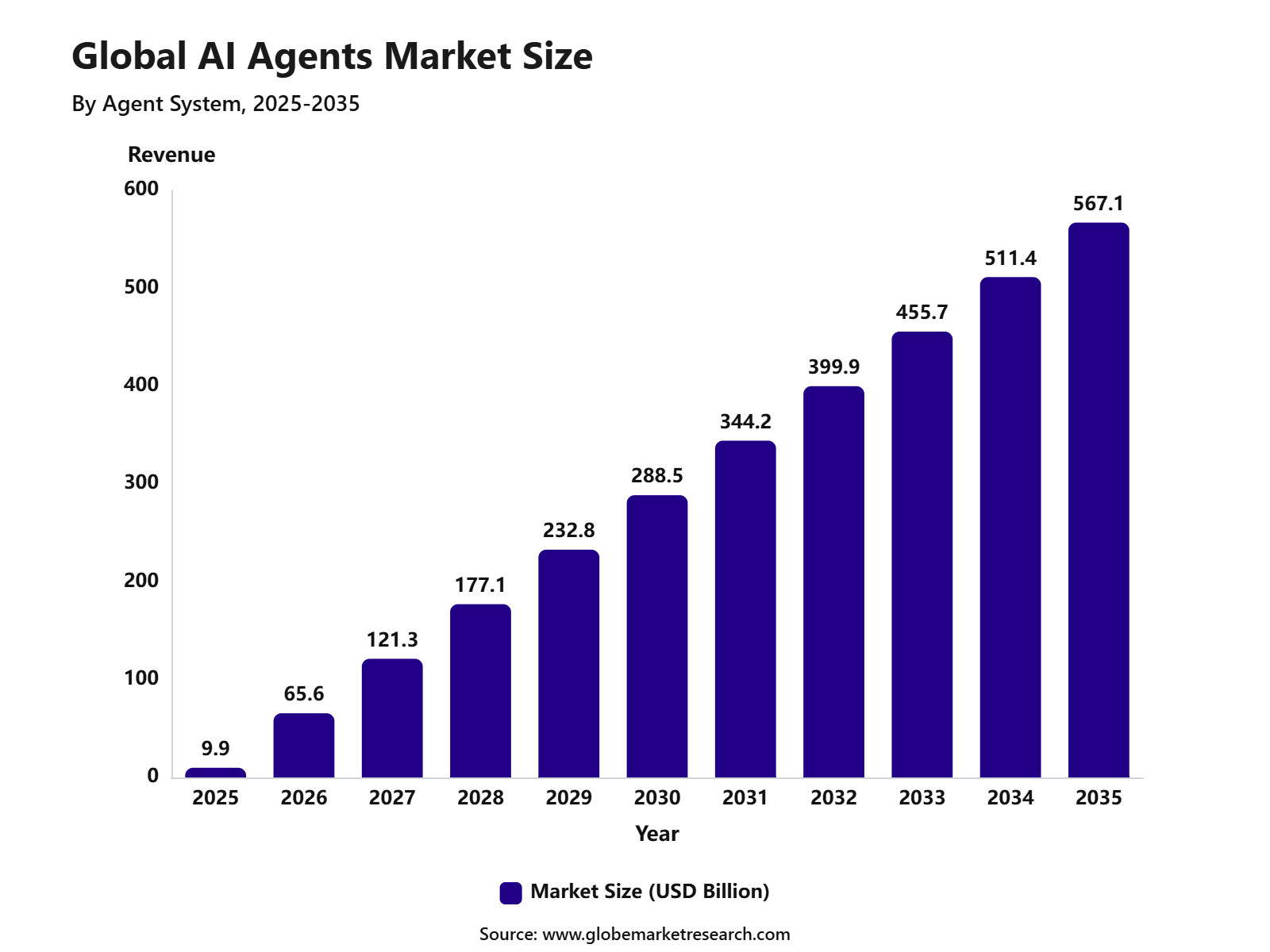
AI Agents Market Size
AI Agents Market Top Takeaways
Based on data from Globe Market Research, The Global AI Agents Market was valued at USD 9.9 billion in 2025 and is projected to reach USD 567.1 billion by 2035, growing at a CAGR of 49.9%.
North America led the market with a 42.3% share in 2025, while the U.S. market reached USD 2.7 billion and is expected to grow at a 43.2% CAGR.
Single agent systems held 65.3% share in 2025, supported by simpler deployment, focused task execution, and easier integration with existing enterprise workflows.
Ready-to-deploy agents accounted for 69.7% share in 2025, as businesses preferred faster implementation, pre-built capabilities, and lower development effort.
Productivity and personal assistants captured 31.6% share in 2025, driven by growing use in scheduling, email management, document handling, task tracking, and workflow support.
Enterprises represented 68.1% share in 2025, supported by increasing adoption of AI agents to reduce repetitive work, improve productivity, and support faster business decisions.
North America led the AI agents market with 42.3% share in 2025, supported by strong AI investment, mature cloud infrastructure, and early enterprise adoption.
The U.S. AI agents market reached USD 2.7 billion in 2025 and is projected to grow at a CAGR of 43.2%, driven by rising demand for automation, AI copilots, and intelligent business tools.
AI Agents Market Statistics
According to IBM, AI-enabled workflows are expected to rise from 3% today to 25% by the end of 2025, indicating a clear shift toward agent-led automation.
Around 64% of AI budgets are now allocated to core business functions, showing that AI agents are becoming part of daily enterprise operations.
Nearly 69% of executives identified improved decision-making as the leading benefit of agentic AI systems.
Around 83% of executives expect AI agents to improve process efficiency and business output by 2026.
About 71% of executives believe AI agents will autonomously adapt to workflow changes, strengthening their role in flexible and intelligent enterprise automation.
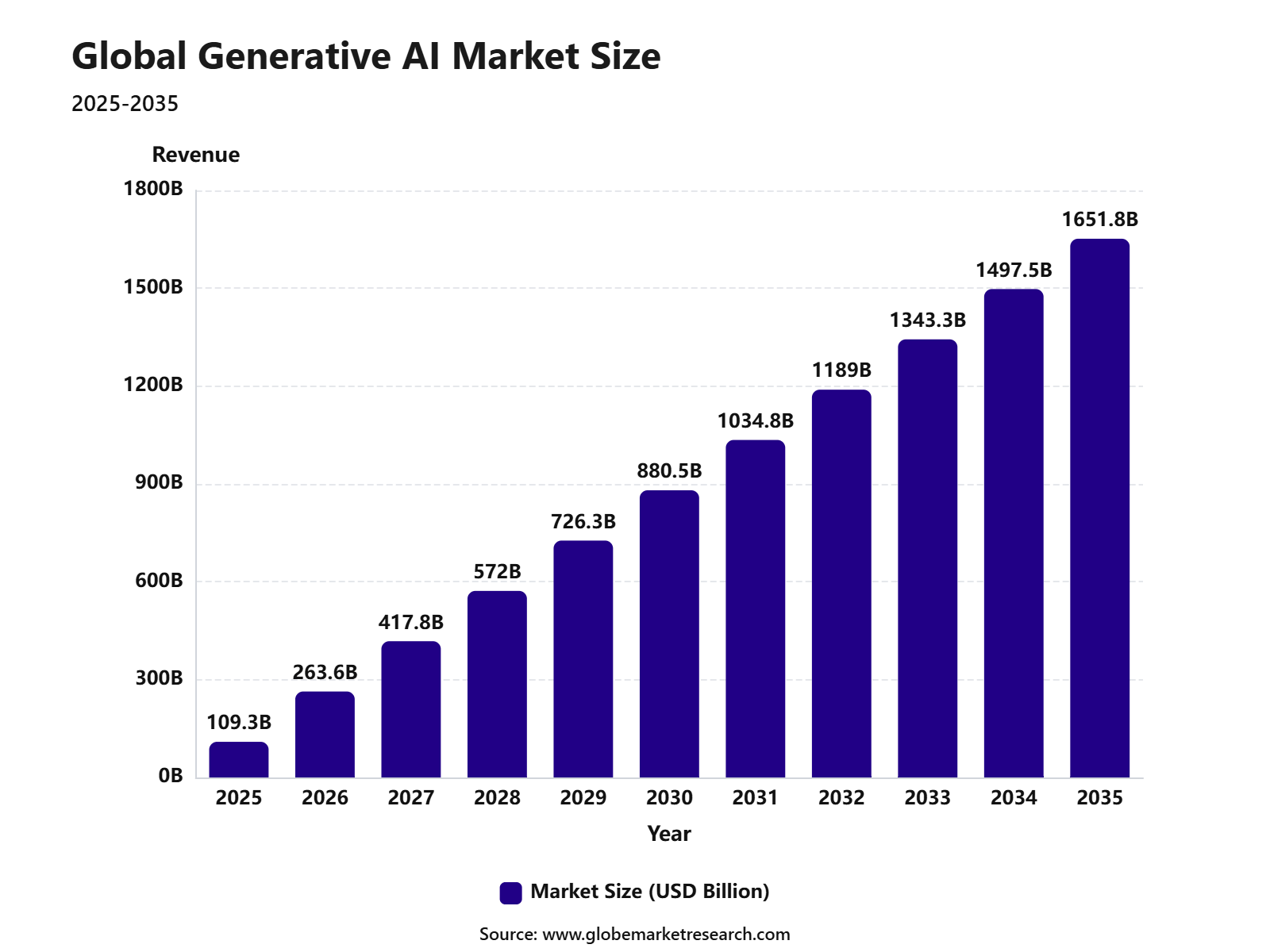
Gen AI Market Size
Key Insight Summary
- According to Globe Market Research, the global Generative AI Market was valued at USD 109.3 billion in 2025 and is projected to reach USD 1,651.8 Bn by 2035, growing at a CAGR of 31.2%. North America led the market with a 49.3% share in 2025.
- Software led the generative AI market with 67.1% share in 2025, supported by strong use of AI platforms, APIs, model development tools, and enterprise-grade applications.
- Transformers held 45.9% share in 2025, driven by their core role in large language models, text generation, coding assistants, image creation, and multimodal AI systems.
- Media and entertainment accounted for 39.5% share in 2025, supported by rising adoption of generative AI in content creation, video production, animation, gaming, advertising, and digital media workflows.
- Natural language processing captured 37.8% share in 2025, driven by demand for chatbots, virtual assistants, content automation, translation, summarization, and enterprise knowledge tools.
- Large language models represented 49.2% share in 2025, supported by rapid adoption of AI copilots, conversational AI, coding tools, and automated content generation platforms.
- App builders held 58.5% share in 2025, as developers, startups, and enterprises increasingly embedded generative AI features into software products, mobile apps, and business platforms.
- North America led the generative AI market with 49.3% share in 2025, supported by strong AI investment, advanced cloud infrastructure, and broad enterprise adoption.
- The U.S. generative AI market was valued at USD 11.6 billion in 2025 and is projected to grow at a CAGR of 38.6%.
Key Difference Between Gen AI and AI Agents
The key difference is action. Gen AI produces content, while AI agents execute tasks. Gen AI is usually reactive because it responds to prompts. AI agents are more proactive because they can follow a goal, use tools, monitor progress, and continue working across multiple steps.
Gen AI is best suited for content-heavy and knowledge-heavy tasks. AI agents are better suited for process-heavy tasks where action, coordination, and tool use are required. This is why Gen AI is widely used in marketing, writing, coding, education, design, and research, while AI agents are gaining traction in customer service, IT operations, software engineering, sales operations, finance, procurement, and enterprise workflows.
Business Impact of Gen AI
Generative AI is improving productivity across content, research, software development, and office work. It allows employees to prepare drafts faster, summarize large documents, search internal knowledge, translate content, and create ideas more quickly. The value is strongest where human review remains part of the process.
The 2026 AI Index found that the estimated value of generative AI tools to U.S. consumers reached USD 172 billion annually by early 2026. This shows that Gen AI is not only being used by companies, but also creating measurable value for individual users through time savings, convenience, and improved output quality.
Business Impact of AI Agents
AI agents are expected to create stronger operational impact because they can reduce manual handoffs and complete multi-step tasks. Their value is not only in content generation, but in execution. They can help businesses reduce response time, improve workflow accuracy, manage repetitive tasks, and support employees with real-time action.
Microsoft’s 2026 Work Trend Index reported 15x year-over-year growth in active agents in Microsoft 365, with growth rising to 18x in large enterprises. The same report found that organizational factors such as culture, manager support, and talent practices account for 67% of reported AI impact, compared with 32% for individual mindset and behavior. This shows that AI agent value depends heavily on workflow design, governance, and adoption readiness.
Use Case Comparison
| Area | Gen AI Use Case | AI Agent Use Case |
|---|---|---|
| Marketing | Writes blogs, ad copy, captions, and campaign ideas. | Builds campaign workflows, checks performance data, drafts updates, and suggests next actions. |
| Customer service | Drafts customer replies and FAQs. | Reads tickets, checks customer records, suggests resolution, updates CRM, and escalates cases. |
| Software development | Writes code, explains errors, and creates documentation. | Tests code, opens tickets, checks repositories, fixes simple issues, and tracks progress. |
| Finance | Summarizes reports and explains financial data. | Checks invoices, validates entries, flags exceptions, and prepares approval workflows. |
| HR | Drafts job descriptions and employee communication. | Screens forms, schedules interviews, sends reminders, and updates applicant systems. |
| Research | Summarizes articles, extracts insights, and creates briefs. | Searches sources, organizes findings, compares data, prepares drafts, and tracks research tasks. |
| Operations | Creates reports and explains process issues. | Monitors workflows, detects delays, alerts teams, and recommends corrective action. |
Gen AI Strengths
Generative AI is strong in content creation, language understanding, summarization, and idea generation. It is easy to use and does not always need deep technical integration. This makes it suitable for quick productivity gains across teams.
It is also flexible across industries. Healthcare teams can use it for documentation support, legal teams can use it for document review, marketing teams can use it for content creation, and software teams can use it for coding assistance. Its broad usability is one reason adoption has grown so quickly.
AI Agent Strengths
AI agents are strong in task completion, workflow automation, and business system interaction. They can connect with tools, use memory, follow rules, and take action across multiple steps. This makes them more powerful for enterprise automation than basic Gen AI tools.
The strongest early value is being seen in productivity, cost reduction, faster decisions, and customer experience. However, the value depends on how well the agent is connected to trusted data, secure systems, and clear approval rules. Without governance, agents can create operational and compliance risks.
Key Risks
Generative AI risks are mainly linked to output quality. It can produce inaccurate content, outdated information, biased responses, or unsupported claims. For business use, human review is still required, especially in legal, financial, medical, and regulated content.
AI agent risks are higher because agents can take action. They may access sensitive data, use the wrong tool, complete the wrong task, or make a workflow error at scale. The 2025 AI Agent Index reviewed 30 deployed agentic AI systems and found uneven transparency around safety, evaluations, and societal impact. This highlights the need for stronger monitoring, permission control, and audit trails.
Which is Better for Business?
Generative AI is better when the main requirement is content, analysis, summarization, or knowledge support. It is easier to adopt, easier to train employees on, and usually faster to deploy. For most companies, Gen AI is the first step in AI adoption.
AI agents are better when the main requirement is execution. They are useful when tasks involve multiple systems, repeated steps, approvals, and data checks. Companies should adopt AI agents after they have clear processes, clean data, secure access controls, and defined human review points.
Final Conclusion
Generative AI creates content, while AI agents complete tasks. Gen AI is already widely adopted and has become a major productivity tool for individuals and enterprises. AI agents are the next stage, where AI moves from answering questions to executing business workflows.
The market direction is clear. Gen AI will remain the foundation layer, while AI agents will become the execution layer. Businesses that combine both carefully will gain stronger productivity, faster decisions, better customer response, and more efficient workflows. However, long-term success will depend on governance, trusted data, human oversight, and clear measurement of business value.
- Log in to post comments