
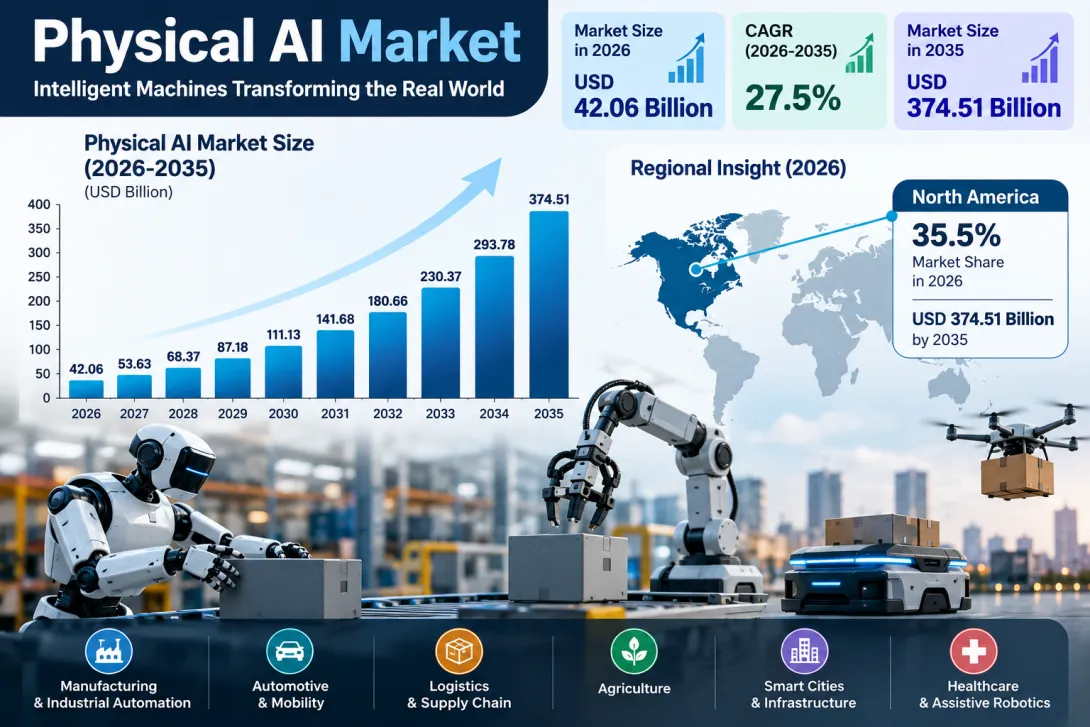
Physical AI Market Size and Forecast (2026-2035)
The Physical AI Market was valued at approximately USD 42.9 billion in 2026 and is projected to reach USD 401.90 billion by 2035, expanding at a CAGR of approximately 28.2% during the forecast period. Market growth is being driven by increasing adoption of intelligent robotics, autonomous systems, industrial automation, and AI-powered machines capable of understanding and interacting with real-world environments.
North America dominated the Physical AI Market with a 35.8% revenue share in 2026, representing approximately USD 15.36 billion in market value. The region's leading position is supported by strong investments in artificial intelligence research, advanced robotics, autonomous mobility, and intelligent manufacturing infrastructure.
The United States remains a major contributor, benefiting from established technology companies, robotics developers, semiconductor manufacturers, and growing demand for automation across automotive, aerospace, logistics, and healthcare industries. Industrial robot installations in the United States increased by 11% in 2025 to approximately 38,000 units, reflecting continued investment in manufacturing automation.
Want to learn more about this market? Contact us at sales@insightmarkresearch.com for detailed insights and customized research solutions.
Key Takeaway Insights
Hardware accounted for 54.9% of the Physical AI Market by component, supported by growing demand for advanced sensors, AI processors, robotic actuators, cameras, and intelligent control systems. These components enable AI-powered machines to perceive their surroundings, process real-time information, and perform physical tasks with greater precision.
Robotics captured 48.5% of the market by Physical AI type, driven by increasing adoption of autonomous robots, humanoid robots, collaborative robots, and intelligent robotic systems across industrial and commercial applications. Advances in machine learning, computer vision, and robotic manipulation are improving their ability to operate in complex environments.
Manufacturing represented 30.3% of the market by end user, reflecting increasing investment in intelligent factory automation, AI-powered robotic assembly, automated material handling, and predictive maintenance. Manufacturers are adopting Physical AI solutions to improve production efficiency, reduce operational downtime, and enhance workplace safety.
North America led the Physical AI Market with a 35.8% regional share, supported by strong investment in artificial intelligence research, advanced robotics development, established semiconductor and automation industries, and growing adoption of intelligent machines across manufacturing, logistics, healthcare, and other industries.
Top 10 Physical AI Statistics 2026
- 5.079 million industrial robots were operating in factories worldwide at the end of 2025, representing a 9% increase compared with the previous year.
- 603,000 industrial robots were newly installed globally during 2025, an annual increase of 11% and the first time installations exceeded 600,000 units.
- According to International Federation of Robotics, 66,000 collaborative robots were installed worldwide in 2025, accounting for approximately 11% of new industrial robot installations.
- Nearly 250,000 professional service robots were sold worldwide in 2025, representing 24% annual growth.
- 117,500 transportation and logistics robots were sold globally in 2025, representing 47% of professional service robot sales.
- Approximately 7,000 full-size humanoid robots were sold worldwide in 2025 for commercial and professional applications.
- 8,400 surgical robots were sold worldwide in 2025, an increase of 57% from the preceding year.
- Only 3% of surveyed organizations reported extensive Physical AI integration in the 2026 Deloitte State of AI research, while 18% expected to reach that level within two years.
- 41% of surveyed organizations expected Physical AI to transform their operations within three years, compared with 5% already reporting transformational impact.
- Over 1 million robots had been deployed across Amazon's operations by June 2025, with its DeepFleet AI system designed to improve robot fleet travel efficiency by 10%.
Market Share Analysis
By Component: Hardware Dominates with 54.9% Market Share in 2026
The hardware segment dominated the global Physical AI Market, accounting for 54.9% of total revenue in 2026, representing approximately USD 23.55 billion. This leadership is primarily attributed to increasing demand for AI-enabled processors, advanced sensors, robotic actuators, cameras, control systems, and intelligent computing devices. Hardware plays an essential role in physical AI systems by allowing machines to collect environmental data, understand their surroundings, and perform real-world tasks.
The growing deployment of autonomous robots, industrial automation equipment, humanoid systems, and intelligent mobility solutions is supporting demand for specialized hardware. Manufacturers are also investing in edge AI chips, vision sensors, and high-performance computing platforms to improve real-time processing, reduce response times, and increase machine reliability in complex operating environments.
The expansion of industrial robotics provides strong evidence of increasing demand for intelligent machine hardware. According to the latest World Robotics 2026 findings, 603,000 industrial robots were installed worldwide in 2025, an increase of 11%, while the global operational stock reached approximately 5.08 million units, growing by 9%. These figures reflect the wider expansion of the installed robotics base, although not all industrial robots use physical AI capabilities.
Advancements in AI-integrated processors, multimodal sensing technologies, and simulation-based robotic development are supporting the transition from traditional automated machines to more adaptive systems. In March 2026, NVIDIA expanded its physical AI ecosystem through new world models, simulation frameworks, and robot foundation models designed to support the development and deployment of intelligent robots.
By Physical AI Type: Robotics Leads with 48.5% Market Share in 2026
The robotics segment accounted for the largest share of the global Physical AI Market at 48.5% in 2026, representing an estimated USD 20.81 billion in revenue. This strong market position is supported by increasing adoption of autonomous robots, humanoid robots, collaborative robots, and intelligent robotic systems across industrial and commercial applications. Physical AI is transforming conventional robotics by enabling machines to understand their surroundings, recognize objects, make decisions, and adjust movements according to changing conditions.
Industries such as manufacturing, logistics, healthcare, agriculture, and construction are increasingly exploring AI-powered robotic solutions to improve operational efficiency, reduce manual intervention, and perform complex tasks. Improvements in machine vision, robotic manipulation, reinforcement learning, and AI-based motion planning are also expanding the range of activities that robots can perform with limited human supervision.
Recent developments highlight the expanding commercial applications of advanced robotics. The latest industry findings released in September 2026 indicate that global professional service robot shipments increased by 24% to nearly 250,000 units in 2025. Transportation and logistics remained the largest application, with approximately 117,500 robots sold, an increase of 21%. Additionally, around 7,000 full-size humanoid robots were sold globally in 2025, reflecting early commercial interest in human-like robotic systems.
By End User: Manufacturing Holds 30.3% Market Share in 2026
The manufacturing segment led the global Physical AI Market with a 30.3% revenue share in 2026, equivalent to approximately USD 13.00 billion. This position is attributed to growing demand for intelligent production systems, industrial robots, automated quality inspection, and AI-powered material handling across manufacturing facilities. Physical AI technologies are being adopted to improve production accuracy, reduce unplanned downtime, optimize assembly operations, and support flexible manufacturing processes.
Automotive, electronics, semiconductor, aerospace, metal fabrication, and machinery manufacturers represent important areas of demand due to their requirements for precision, reliability, and consistent production quality. The integration of computer vision, edge computing, and intelligent robotic control systems allows manufacturing equipment to identify defects, adjust to production variations, and respond to operational changes more effectively than conventional fixed automation.
The latest industrial robotics statistics highlight the continued expansion of automation in manufacturing. In September 2026, global industrial robot installations were reported to have exceeded 600,000 units during 2025, while worldwide demand is forecast to reach approximately 655,000 installations in 2026, representing projected annual growth of 9%.
Increasing investment in AI-supported manufacturing is also encouraging the development of robots that can learn from simulated and real production environments. In July 2026, ABB Robotics and NVIDIA outlined an approach combining robotic vision, digital twins, synthetic data, and AI validation to improve the development and deployment of intelligent manufacturing systems. The approach addresses a major industry challenge by allowing robotic applications to be tested under different operating conditions before physical implementation.
By Region: North America Dominates with 35.8% Market Share in 2026
North America accounted for the largest share of the global Physical AI Market at 35.8% in 2026, representing an estimated USD 15.36 billion in revenue. The region's leadership is supported by substantial investments in artificial intelligence, advanced robotics, autonomous vehicles, intelligent manufacturing, and specialized computing infrastructure. The United States remains a major contributor due to its concentration of AI technology developers, robotics companies, semiconductor manufacturers, research institutions, and industrial automation providers.
Growing demand for autonomous warehouse systems, AI-enabled industrial robots, intelligent medical equipment, and advanced mobility technologies is supporting market development. The presence of companies such as NVIDIA, Tesla, Boston Dynamics, Figure AI, and other robotics developers contributes to research, product development, and commercialization of physical AI technologies. Investment in domestic manufacturing capabilities and industrial modernization is also encouraging businesses to adopt advanced automation systems.
Recent robotics data indicates continued growth in North American industrial automation. In September 2026, updated statistics showed that industrial robot installations in the United States increased by 12% to nearly 38,500 units in 2025, making it the world's second-largest industrial robot installation market after China. Canada also recorded positive growth, with installations rising by 5% to almost 4,000 units during the same year.
Alongside increasing industrial adoption, collaboration between AI developers, robotics manufacturers, and cloud computing companies is accelerating the development of intelligent machines. The expansion of physical AI research into autonomous navigation, robotic manipulation, real-time perception, and simulation-based learning is expected to support wider commercial deployment across North American industries. Continued investments in manufacturing automation, logistics infrastructure, and AI-enabled healthcare technologies are creating additional opportunities for regional market participants.
AI and Technology Impact
AI Impact
Artificial intelligence and advanced technologies are significantly transforming the global Physical AI Market, enabling machines to understand their surroundings, make independent decisions, and perform complex physical tasks. The integration of machine learning, computer vision, reinforcement learning, and vision-language-action (VLA) models is helping robots move beyond fixed instructions toward more flexible and adaptive operations.
AI-powered systems can identify objects, interpret human commands, plan movements, and adjust their actions based on real-time environmental information. These capabilities are creating opportunities in manufacturing, autonomous vehicles, healthcare robotics, warehousing, and industrial automation.
According to the International Federation of Robotics, its September 2026 report showed that more than 5 million industrial robots were operating in factories worldwide in 2025, representing 9% annual growth. Global annual installations also increased by 11%, exceeding 600,000 units, reflecting continued expansion of robotics infrastructure that can support future physical AI deployment.
Advancements in generative AI, robotics foundation models, edge computing, digital twins, and simulation technologies are further accelerating physical AI development. In March 2026, NVIDIA introduced new Cosmos world models, Isaac simulation frameworks, and Isaac GR00T models designed to improve robotic learning, reasoning, and physical task execution.
The growing use of synthetic training data and AI-powered simulation is also addressing a major challenge in robotics development: the high cost of collecting real-world training information. In October 2026, Chinese robotics developer DexForce reported using virtual simulation to train humanoid robots, supported by a Series B funding round of approximately USD 147 million. The company's approach illustrates how simulated environments can support robotic learning while reducing dependence on physical demonstrations.
Technology Impact Insights
AI advancements are expected to play a central role in the Physical AI Market's projected expansion from USD 42.9 billion in 2026 to USD 401.90 billion by 2035. The strongest opportunities are emerging in general-purpose robotics, autonomous navigation, intelligent robotic manipulation, AI-enabled machine vision, and simulation-based robotic training. Companies are increasingly focusing on systems that can learn new tasks, operate safely alongside workers, and integrate with existing industrial infrastructure.
The combination of advanced AI models, energy-efficient processors, and affordable sensors could gradually reduce deployment costs and improve commercial accessibility. However, high computing requirements, limited availability of quality training data, technical integration challenges, and uncertain returns on investment remain important market constraints. Technology providers that can demonstrate reliable performance, measurable productivity improvements, and lower total ownership costs are likely to be better positioned as physical AI adoption expands across industrial and commercial sectors.
Industry Trends Analysis
Intelligent Robotics Adoption: Industries are moving from fixed automation systems toward AI-powered robots capable of learning, identifying objects, and adjusting movements in real time.
Increasing Robotics Investment: The global industrial robot installation market reached a record value of approximately USD 16.7 billion, according to the International Federation of Robotics' January 2026 industry outlook.
Humanoid Robot Development: Companies are developing humanoid robots for manufacturing, warehouse handling, industrial assistance, and commercial operations.
AI Integration: Machine learning, computer vision, spatial intelligence, and robotic foundation models are improving autonomous decision-making and physical task execution.
Simulation-Based Training: Digital twins and synthetic data are increasingly being used to train robots before deployment in real environments.
Key Insight: Demand is shifting toward intelligent robotic systems that offer flexibility, reliable performance, and measurable productivity improvements.
Key Market Segments
By Component
- Hardware
- Software
- Services
By Physical AI Type
- Robotics
- Autonomous Vehicles & Machines
- Vision AI & Smart Spaces
- Other Physical AI Systems
By End User
- Manufacturing
- Automotive & Transportation
- Logistics & Warehousing
- Healthcare & Life Sciences
- Construction & Infrastructure
- Agriculture
- Government & Defense
- Others
By Region
- North America
- Europe
- Asia Pacific
- Latin America
- Middle East & Africa
Market Growth Drivers
Increasing Industrial Automation: Manufacturing companies are adopting AI-powered robots to improve production efficiency, inspection accuracy, and material handling.
Workforce Shortages: Difficulty recruiting workers for repetitive, physically demanding, and specialized industrial tasks is encouraging robotic automation.
Advancement in AI Computing: Improved AI processors, embedded computing platforms, and machine vision technologies are enabling faster robotic decision-making.
Strategic Technology Partnerships: In March 2026, NVIDIA expanded collaborations with FANUC, KUKA, Universal Robots, and Yaskawa to support physical AI development.
Operational Cost Optimization: Companies are investing in intelligent robots to reduce production downtime, improve equipment utilization, and support continuous operations.
Key Insight: Productivity requirements, workforce constraints, and improved robotic intelligence are expected to remain important growth drivers.
Market Restraints
High Initial Investment: Physical AI systems require expensive computing hardware, sensors, actuators, control equipment, and software integration.
Maintenance Expenses: Regular calibration, software updates, mechanical repairs, and technical support increase total ownership costs.
Limited Commercial Maturity: General-purpose humanoid robots still face difficulties performing unfamiliar tasks consistently in real-world conditions.
Complex Infrastructure Integration: Existing manufacturing facilities may require equipment modifications and additional safety systems before deployment.
Uncertain Investment Returns: Some organizations are delaying adoption because the financial benefits of advanced autonomous robots remain difficult to estimate.
Key Insight: High ownership costs, technical complexity, and limited operating reliability may restrict adoption among smaller enterprises.
Market Opportunities
Healthcare Robotics: Medical robot sales increased by approximately 19% in 2025, according to the IFR's September 2026 report, indicating growing interest in robotic healthcare applications.
Autonomous Warehouse Systems: Opportunities are expanding in intelligent sorting, inventory transportation, robotic picking, and automated order fulfillment.
Agricultural Automation: Physical AI can support crop monitoring, precision harvesting, autonomous agricultural equipment, and automated inspection.
Advanced Robotic Components: Demand is developing for high-resolution sensors, AI processors, precision actuators, and energy-efficient robotic hardware.
Robotics-as-a-Service: Subscription-based robotic deployment offers opportunities to serve customers seeking automation without large upfront investments.
Key Insight: Healthcare automation, intelligent logistics, robotic components, and specialized industrial applications represent important opportunities.
Market Challenges
Real-World Reliability: Robots must operate accurately under changing lighting conditions, unfamiliar environments, and unexpected physical obstacles.
Training Data Limitations: Obtaining sufficient real-world data for robotic manipulation and complex physical tasks remains expensive.
Simulation-to-Reality Gap: Performance achieved during virtual training may differ when robots encounter actual industrial conditions.
Cybersecurity Risks: Connected robots can be exposed to unauthorized access, software vulnerabilities, and operational disruption.
Safety Requirements: Autonomous machines must maintain reliable operation when interacting with people and expensive equipment.
Key Insight: Improving real-world accuracy, training efficiency, cybersecurity, and safety remains essential for large-scale deployment.
Key Players
- NVIDIA Corporation
- ABB Ltd.
- FANUC Corporation
- Yaskawa Electric Corporation
- Qualcomm Technologies, Inc.
- Boston Dynamics
- Agility Robotics
- Figure AI
- Tesla, Inc.
- Amazon Robotics
- Hyundai Motor Group
- SoftBank Robotics
- Moog Inc.
- Festo
- Siemens AG
- Universal Robots
- NEURA Robotics
- Unitree Robotics
- Physical Intelligence
- Google DeepMind
Regulatory Landscape
- European Union AI Act: Certain high-risk AI requirements are scheduled to apply from December 2, 2027, with requirements for specified regulated-product AI systems applying from August 2, 2028.
- Industrial Robot Safety: ISO 10218-1:2025 addresses industrial robot safety, while ISO 10218-2:2025 covers robotic applications and integration.
- Product Compliance: Manufacturers must evaluate applicable machinery safety, equipment certification, product liability, and operational risk requirements.
- Cybersecurity Regulation: Connected robotic systems require secure software, access management, monitoring, and protection against unauthorized operation.
- Data Protection: AI-enabled robots processing personal information must comply with applicable privacy and data protection laws.
- Key Insight: Early investment in safety engineering, regulatory compliance, and cybersecurity can reduce commercial deployment risks.
Consumer and Buyer Behaviour
- Increasing Consumer Adoption: Consumer service robot sales increased by approximately 37% to 34.2 million units in 2025, according to the IFR.
- Industrial Purchasing Priorities: Manufacturing customers focus on productivity improvement, system reliability, integration requirements, and investment returns.
- Commercial Evaluation: Businesses increasingly use pilot projects and operational demonstrations before approving large-scale robotic deployments.
- Preference for Flexible Contracts: Subscription models, leasing, and robotics-as-a-service arrangements can improve access to intelligent automation.
- Safety and Trust: Customers prefer technologies with dependable performance, clear operating procedures, cybersecurity protection, and effective support.
- Long-Term Vendor Relationships: Software updates, maintenance services, training, and equipment availability influence purchasing decisions.
- Key Insight: Customers increasingly prioritize practical business outcomes and total ownership costs rather than advanced AI capabilities alone.
Funding and Investment Analysis
- Major Robotics Funding: Skild AI announced a USD 1.4 billion Series C funding round in January 2026, supporting robotic foundation model development and commercial expansion.
- Humanoid Robotics Investment: Apptronik announced a USD 520 million Series A extension in February 2026, supporting production and deployment of its Apollo robots.
- Simulation Technology Funding: DexForce reported raising approximately USD 147 million in October 2026 to support robotics development and simulation-based training.
- Investor Participation: Venture capital firms, technology companies, semiconductor manufacturers, and strategic investors are financing robotics development.
- Capital Allocation: Funding is being directed toward AI model training, robotics manufacturing, computing infrastructure, engineering, and commercial operations.
- Investment Risks: High research costs, uncertain deployment timelines, manufacturing expenses, and competition can affect investment performance.
- Key Insight: Funding activity demonstrates investor interest, but sustainable business performance will depend on commercial adoption, revenue generation, and profitability.
Business Opportunities
- Logistics Automation: Transportation and logistics accounted for approximately 47% of professional service robot shipments in 2025, according to IFR data.
- Robotic System Integration: Manufacturers need specialized services to connect physical AI equipment with existing machinery and enterprise software.
- Machine Vision Applications: Opportunities exist in automated inspection, defect detection, quality control, and intelligent product handling.
- Robotics-as-a-Service: Subscription-based deployment allows providers to generate recurring revenue while reducing customer capital requirements.
- Software Development: Companies can offer autonomous navigation, robotic control, fleet management, and simulation applications.
- Maintenance and Training: Increasing robotic deployment is expected to create demand for technical support, equipment servicing, and workforce training.
- Key Insight: Industry-specific solutions and recurring service models offer practical opportunities for businesses entering the Physical AI Market.
Strategic Recommendations
- Prioritize Commercial Applications: Focus on warehouse automation, robotic inspection, intelligent material handling, and manufacturing applications with measurable customer demand.
- Strengthen AI Capabilities: Invest in robotic foundation models, spatial perception, autonomous navigation, and adaptive control technologies.
- Reduce Deployment Costs: Develop modular hardware, reusable software, and standardized integration processes to make physical AI more accessible.
- Build Strategic Partnerships: Collaborate with semiconductor manufacturers, AI developers, robotics suppliers, and industrial system integrators.
- Improve Product Reliability: Invest in real-world testing, simulation validation, safety engineering, and continuous performance monitoring.
- Expand Recurring Revenue: Introduce maintenance contracts, software subscriptions, robotic fleet management, and robotics-as-a-service offerings.
- Ensure Regulatory Compliance: Incorporate machinery safety, cybersecurity, data protection, and AI governance requirements into product development.
- Measure Commercial Performance: Track equipment uptime, task completion accuracy, deployment costs, operating savings, customer retention, and return on investment.
- Key Insight: Companies offering reliable, affordable, and industry-specific physical AI solutions are expected to be better positioned for sustained commercial growth.
- Log in to post comments