
Introduction
EdTech Statistics: Education technology in 2026 is moving beyond basic online courses and learning-management systems toward AI tutors, adaptive learning, digital assessment, skills platforms, connected classrooms and AI-assisted teaching. The strongest shift is the rapid adoption of generative AI across schools and universities. At the same time, infrastructure gaps remain substantial. Many institutions have access to thousands of digital tools, but actual classroom use is concentrated among a relatively small number of platforms. Global connectivity also remains uneven, particularly in primary and secondary education.
Editor's Choice: Top 10 EdTech Statistics 2026
92% of surveyed students have used AI for school-related purposes, showing that AI has moved into mainstream student behavior.
88% of educators have used AI for education-related activities.
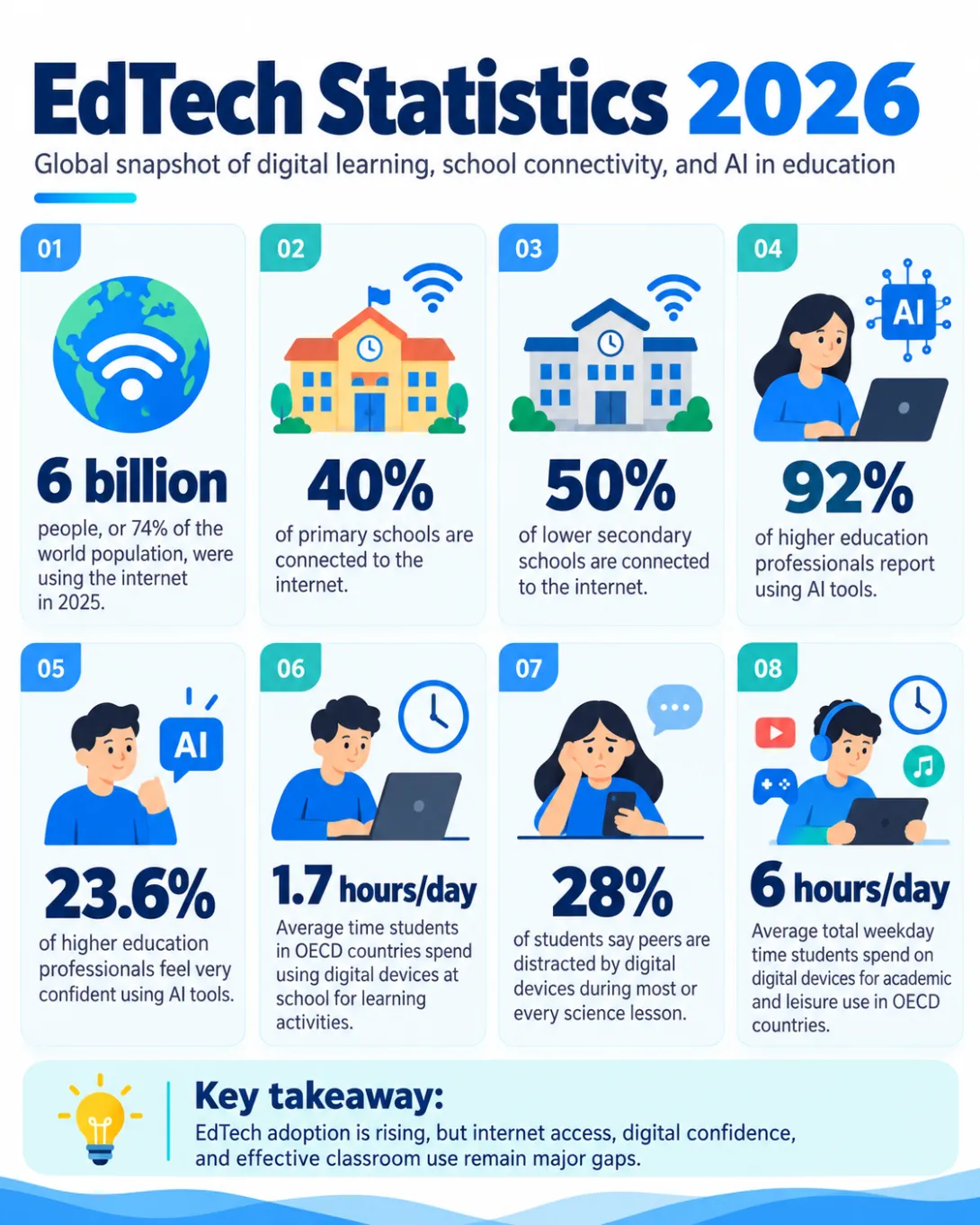
Only 40% of primary schools worldwide are connected to the internet, highlighting the continued global digital-access gap.
Coursera reached 205 million registered learners by March 2026.
Duolingo had 52.7 million daily active users at the end of 2025 entering 2026.
Khan Academy recorded 104.9 million yearly active learners during the 2024-25 school year.
Khanmigo reached 2 million students, educators and parents, showing significant growth in AI-assisted learning.
U.S. K-12 districts had access to an average of 3,001 different digital tools, according to Instructure's 2026 dataset.
Only 37% of lower-secondary teachers reported using AI for their jobs in the OECD's TALIS data.
The combined Coursera-Udemy learning ecosystem reached approximately 290 million learners following their 2026 combination.
Edtech Market Size
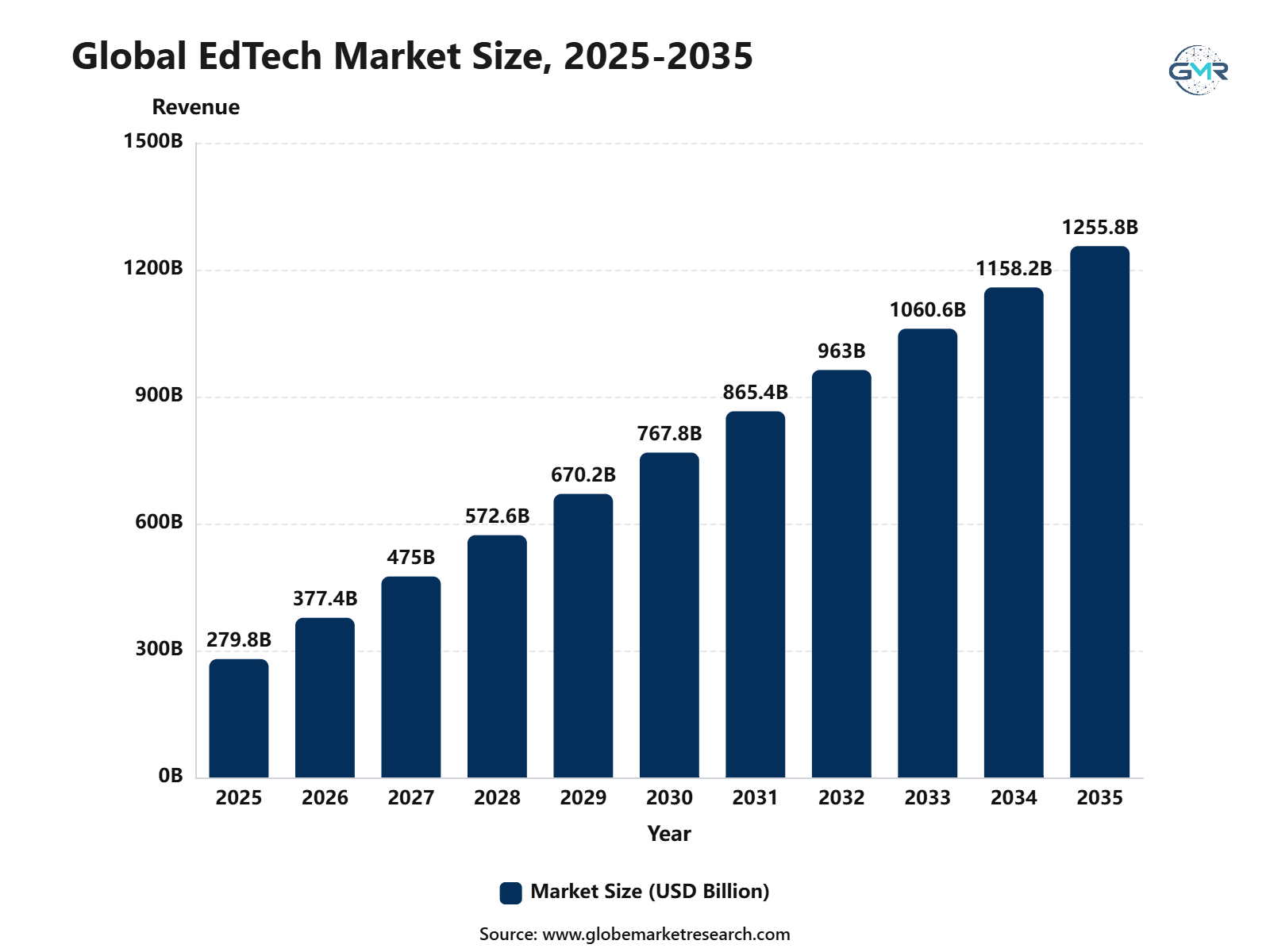
According to Globe Market Research, The global EdTech market reached USD 279.8 billion in 2025 and is forecast to grow to USD 1,255.8 billion by 2035, registering a CAGR of 16.2% during the forecast period. Market expansion is driven by increasing adoption of digital learning platforms, AI-powered educational tools, personalized learning solutions, and technology-enabled classrooms.
North America accounted for the largest regional share of 39.8% in 2025, supported by established digital education infrastructure and continued investment in learning technologies. The U.S. EdTech market was valued at USD 53.9 billion in 2025 and is projected to expand at a 15.6% CAGR, reflecting growing demand for adaptive learning platforms, AI-assisted teaching solutions, and digital tools across K-12, higher education, and professional training.
EdTech Market: Dominant Segments
- By Sector: K-12 dominated the market with a 59.1% share.
- By Type: Hardware accounted for the largest market share of 41.9%.
- By Deployment Mode: On-Premise Solutions held the dominant position with a 72.3% share.
- By End User: Individual Learners represented the leading segment with a 47.8% share.
- By Region: North America dominated the global EdTech market with a 39.8% share.
- By Country: The U.S. EdTech Market was valued at USD 53.9 billion and is projected to expand at a 15.6% CAGR.
AI in Education Statistics
Artificial intelligence has become the most important technology trend affecting EdTech in 2026.
58% of education leaders said their institutions were already implementing or scaling AI rather than simply experimenting with it
78% of education leaders reported that their school-related AI use increased during the previous year.
76% of educators said their usage had increased.
Among students, the corresponding increase was 65%.
87% of educators and education leaders believe effective and responsible AI use is important for students' futures.
79% of students agreed that AI skills will be important for their future.
Yet 77% of students reported receiving no formal AI training.
53% of educators also said they had not received formal AI training..
Teacher AI Adoption Statistics
- Teachers are increasingly using AI for planning, content preparation and administrative support, but adoption remains uneven.
- The OECD found that 57% of lower-secondary teachers believe AI can help write or improve lesson plans.
- At the same time, 72% believe AI can harm academic integrity by allowing students to submit AI-generated work as their own.
- Demand for ongoing training is also high:
- 66% of educators want their institution to provide AI training monthly or quarterly.
- Only 23.6% of higher-education professionals describe themselves as very confident using AI tools, despite widespread usage.
Student AI Learning Statistics
Students increasingly use AI for:
- Summarizing study materials
- Explaining difficult concepts
- Brainstorming
- Writing support
- Personalized study assistance
- Language learning
- Coding
- Research
Microsoft reported that roughly one-third of surveyed students use AI specifically to learn or study in a way that better matches their preferred learning style. However, OECD research warns that better performance while using a general-purpose AI tool does not automatically mean stronger learning. Students may complete tasks more successfully while still failing to develop independent understanding if AI simply produces the answer.
AI Tutor Statistics
AI tutoring is becoming one of the most visible EdTech applications.
Khan Academy reported more than 108 million cumulative Khanmigo interactions since the AI tutor's launch.
During the latest school year, users generated an average of approximately 269,000 Khanmigo interactions on weekdays.
However, only around 15% of students who had access to Khanmigo actively engaged with it, demonstrating that availability does not automatically translate into sustained use.
Within U.S. district partnerships, approximately 770,000 students used Khanmigo alongside Khan Academy's classroom programmes.
Khanmigo sign-ups increased 731% year over year during the reported school year, illustrating the speed at which education-specific AI assistants can scale when integrated with existing learning platforms.
K-12 EdTech Statistics
- K-12 institutions have accumulated very large digital-learning ecosystems, but schools are increasingly trying to reduce unnecessary tool duplication.
- Instructure's 2026 analysis covered 12.67 million K-12 users in the United States, including students and educators.
- The dataset included:
- More than 11 million students
- 618,068 educators
- Over 1,000 integrated learning tools.
- Despite the large number of available applications, the average student actively used only four LTI-connected tools during the year.
- Educators also averaged just four actively used integrated tools.
- This gap between availability and actual usage suggests that K-12 procurement is beginning to shift from "more tools" toward fewer platforms that demonstrate measurable educational value.
Higher Education EdTech Statistics
Higher education remains one of the largest institutional users of learning-management systems, video platforms, digital course materials and assessment technologies.
Instructure's 2026 higher-education analysis covered almost 19.5 million U.S. users.
Institutions averaged 28 unique LTI integrations, while individual instructors averaged four and students averaged five.
Interestingly, no dedicated AI application ranked among the top 100 integrated tools in that analysis. This does not mean universities are not using AI. Instead, much AI use is taking place through general tools outside formal institutional LMS integrations.
This creates an important EdTech opportunity around secure, institutionally managed AI rather than unmanaged personal AI accounts.
Higher Education AI Statistics
- UNESCO reports that 92% of higher-education professionals use AI tools in some capacity.
- The contrast between very high general usage and relatively limited formal platform integration suggests a fragmented environment.
- Universities are increasingly evaluating AI for:
- Teaching assistants
- Student tutoring
- Assessment
- Research support
- Student services
- Admissions
- Course design
- Administrative automation
- The main institutional challenge is increasingly becoming governance and integration rather than simple access to AI.
Online Learning Statistics
Online-learning platforms continue to operate at very large global scale.
Coursera added 7.6 million new registered learners during Q1 2026, its largest first-quarter addition at that point.
Its paid enterprise customer base reached 1,729 organizations during the same period.
The company generated approximately USD 196 million in quarterly revenue, increasing 9% year over year.
Consumer revenue grew 10%, while enterprise revenue increased 7%.
These figures indicate that online learning is no longer driven only by individual students. Employers increasingly use digital-learning platforms for workforce reskilling and AI-related training.
Digital Skills and Workforce Learning Statistics
- The combination of Coursera and Udemy created an ecosystem serving approximately 18,000 enterprise customers.
- The combined platform also included around 95,000 instructors, along with hundreds of university and industry partners.
- The consolidation reflects an important EdTech trend: employers increasingly want platforms that connect skills identification, training and verified capability, rather than simply libraries of standalone courses.
Demand is particularly strong around:
- Generative AI
- Data science
- Cybersecurity
- Software engineering
- Cloud computing
- Leadership
- Business analytics
Language Learning Statistics
- Language-learning applications remain among the largest consumer EdTech products.
- Duolingo ended 2025 with 133.1 million monthly active users.
- Its paid subscriber base reached 12.2 million.
- Annual bookings exceeded USD 1 billion for the first time, demonstrating the commercial scale achievable through freemium digital education.
- AI is also increasing the speed at which learning content can be produced. Duolingo published 20,500 learning skills during Q1 2026, compared with 7,100 per quarter during the prior year.
- The company is increasingly applying the same technology beyond languages into math, music and chess.
Major EdTech Applications in 2026
| Application | Primary Role |
|---|---|
| Learning Management Systems | Course delivery and administration |
| AI Tutors | Personalized explanation and guided practice |
| Adaptive Learning | Adjusting content to learner performance |
| Online Courses | Remote and asynchronous education |
| Language Learning Apps | Self-paced language instruction |
| Digital Assessment | Testing and automated feedback |
| Virtual Classrooms | Live remote instruction |
| Teacher AI Assistants | Lesson planning and administrative support |
| Skills Platforms | Professional reskilling and certification |
| Student Analytics | Tracking progress and intervention needs |
| Simulation & VR | Experiential learning |
| AI Literacy Platforms | Responsible AI education |
Key EdTech Trends in 2026
- AI is becoming embedded rather than standalone. AI capabilities are increasingly being built directly into LMS platforms, course systems and tutoring tools.
- AI tutors are shifting from answer generation toward guided learning. The strongest education-focused systems increasingly encourage students to reason rather than simply provide solutions.
- Schools are consolidating software portfolios. Institutions are questioning the value of maintaining thousands of available tools that receive little actual usage.
- Teacher training is becoming a bottleneck. AI adoption has grown much faster than formal professional development.
- Skills-based learning is expanding. Employers are increasingly using digital platforms for continuous reskilling rather than relying only on formal degrees.
- Institutional AI governance is becoming more important. Universities want security, privacy and academic-integrity controls around AI use.
- Connectivity remains fundamental. Advanced AI learning has limited impact where schools still lack dependable internet access and student devices.
Key Takeaway for 2026
EdTech in 2026 is entering an AI-native phase, but adoption is advancing faster than evidence, training and governance. Students and educators are already using AI at high rates, while large online-learning and language platforms now serve hundreds of millions of registered users. At the institutional level, however, schools are becoming more selective about which digital tools they actually deploy.
The most important competitive advantage is therefore shifting from simply providing digital access toward demonstrating better learning outcomes, personalization, teacher productivity, responsible AI use and seamless integration with existing education systems.
The long-term opportunity remains substantial, but the biggest constraint is still unequal access. Advanced AI tutors can improve digital learning only where students have reliable connectivity, appropriate devices and teachers capable of integrating technology effectively into instruction.
Reference Sources
- https://www.unesco.org/en/digital-education?hub=66727
- https://www.instructure.com/press-release/new-instructure-data-shows-k-…
- https://news.microsoft.com/source/2026/06/24/microsofts-new-ai-in-educa…
- https://investor.coursera.com/news/news-details/2026/Coursera-Completes…
- https://www.oecd.org/en/publications/oecd-digital-education-outlook-202…
- https://www.unesco.org/reports/gem-report/en/2026
- Log in to post comments