
Introduction
Custom AI ASIC Statistics: The custom AI ASIC industry recorded significant commercial growth in 2026 as cloud providers and technology companies increased spending on specialized AI processors. Broadcom reported USD 16.7 billion in AI semiconductor revenue in its third fiscal quarter of 2026, representing 221% year-over-year growth. This revenue includes custom AI accelerators and AI networking semiconductors, rather than custom ASICs alone. The figures demonstrate the expanding commercial importance of processors designed for large-scale artificial intelligence workloads.
The industry is also moving toward more specialized hardware for AI training, inference, recommendation systems, and cloud infrastructure. In 2026, Microsoft introduced Maia 200, Google announced its eighth-generation Tensor Processing Units (TPUs), and Meta expanded its in-house MTIA processor roadmap. These developments reflect increasing interest in matching chip architecture to specific computing tasks, particularly where performance, energy consumption, and infrastructure costs are important business considerations.
What is a custom AI ASIC?
A custom AI application-specific integrated circuit (ASIC) is a semiconductor processor designed for a defined set of artificial intelligence workloads. Unlike a broadly programmable graphics processing unit (GPU), an AI ASIC uses specialized computing, memory, and data-movement architectures to improve performance or efficiency for targeted applications. Examples include Google's TPUs, AWS Trainium processors, Microsoft's Maia accelerators, and Meta's MTIA chips.
Key Takeaways: Top 10 Custom AI ASIC Statistics
- Broadcom's AI semiconductor revenue reached USD 10.8 billion in fiscal Q2 2026, increasing 143% year over year, supported by custom AI accelerator and networking demand.
- TSMC generated USD 46.72 billion in total revenue during Q3 2026, a 41.2% year-over-year increase in U.S. dollar terms. This is foundry-wide revenue, not solely AI ASIC manufacturing revenue.
- 2-nanometer technology contributed 8% of TSMC's wafer revenue in Q3 2026, reflecting the commercial ramp-up of its latest manufacturing process.
- Marvell recorded USD 2.739 billion in total revenue in fiscal Q2 2027, reported in August 2026, representing 37% annual growth as demand increased across its data center portfolio.
- Meta confirmed the production deployment of hundreds of thousands of MTIA chips in March 2026, demonstrating the large-scale operational use of custom AI ASICs.
- Google's TPU 8t architecture supports 9,600 chips in one superpod, providing a stated 121 exaFLOPS of computing capacity for AI training.
- AWS Trainium3 delivers 2.52 petaFLOPS of FP8 computing performance per chip, according to its December 2025 product specifications for systems available in 2026.
- Microsoft Maia 200 provides more than 10 petaFLOPS of FP4 computing performance, using a custom chip containing over 140 billion transistors.
- Alphabet projected USD 180 billion to USD 190 billion in capital expenditure for 2026, primarily for technical infrastructure, including equipment and data centers supporting its AI computing systems.
- India reported more than ₹1.64 lakh crore in investment commitments across 12 approved semiconductor manufacturing projects by July 2026. The projects cover several chip categories and are not exclusively focused on AI ASICs.
Editor's Choice: Top 10 Interesting Statistics
- 3.7 times lower compute carbon intensity: Google's April 2026 analysis reported an approximately 3.7-fold improvement for its Ironwood TPU compared with the earlier TPU v5p, using its defined lifecycle measurement.
- 3.9 times faster communication: Meta reported that MTIA 300 completed collective communications 3.9 times faster than its comparison GPU cluster on a 150-billion-parameter recommendation model distributed across 40 accelerators.
- More than 1 million TPUs: Google reported in May 2026 that its JAX and Pathways infrastructure enables distributed training across more than one million TPUs globally. This describes scaling capability, not a count of chips sold.
- 30 benchmark participants: The September 2026 MLPerf Inference v6.1 round received submissions from 30 organizations covering multiple accelerator architectures and computing platforms.
- 43% higher MX4 computing performance: Meta's proposed MTIA 500 architecture offers 43% higher MX4 performance than MTIA 450, based on the company's March 2026 specifications. Mass deployment was scheduled for 2027.
- 144 accelerators per server system: AWS Trn3 UltraServers support configurations with up to 144 Trainium3 processors, delivering 362 FP8 petaFLOPS in the company's specified configuration.
- 192 GiB of memory per chip: Google's seventh-generation Ironwood TPU features 192 GiB of high-bandwidth memory and 7,380 GB/s of memory bandwidth.
- USD 135 billion to USD 145 billion in planned capital spending: Meta's October 21, 2026, financial update specified this full-year expenditure range, including finance lease principal payments.
- 272 MB of integrated SRAM: Microsoft's Maia 200 architecture includes this on-chip memory capacity to support rapid data access during AI inference.
- USD 21.7 billion in projected quarterly AI semiconductor revenue: Broadcom's September 2026 financial guidance anticipated this figure for fiscal Q4, representing a forecast rather than completed sales.
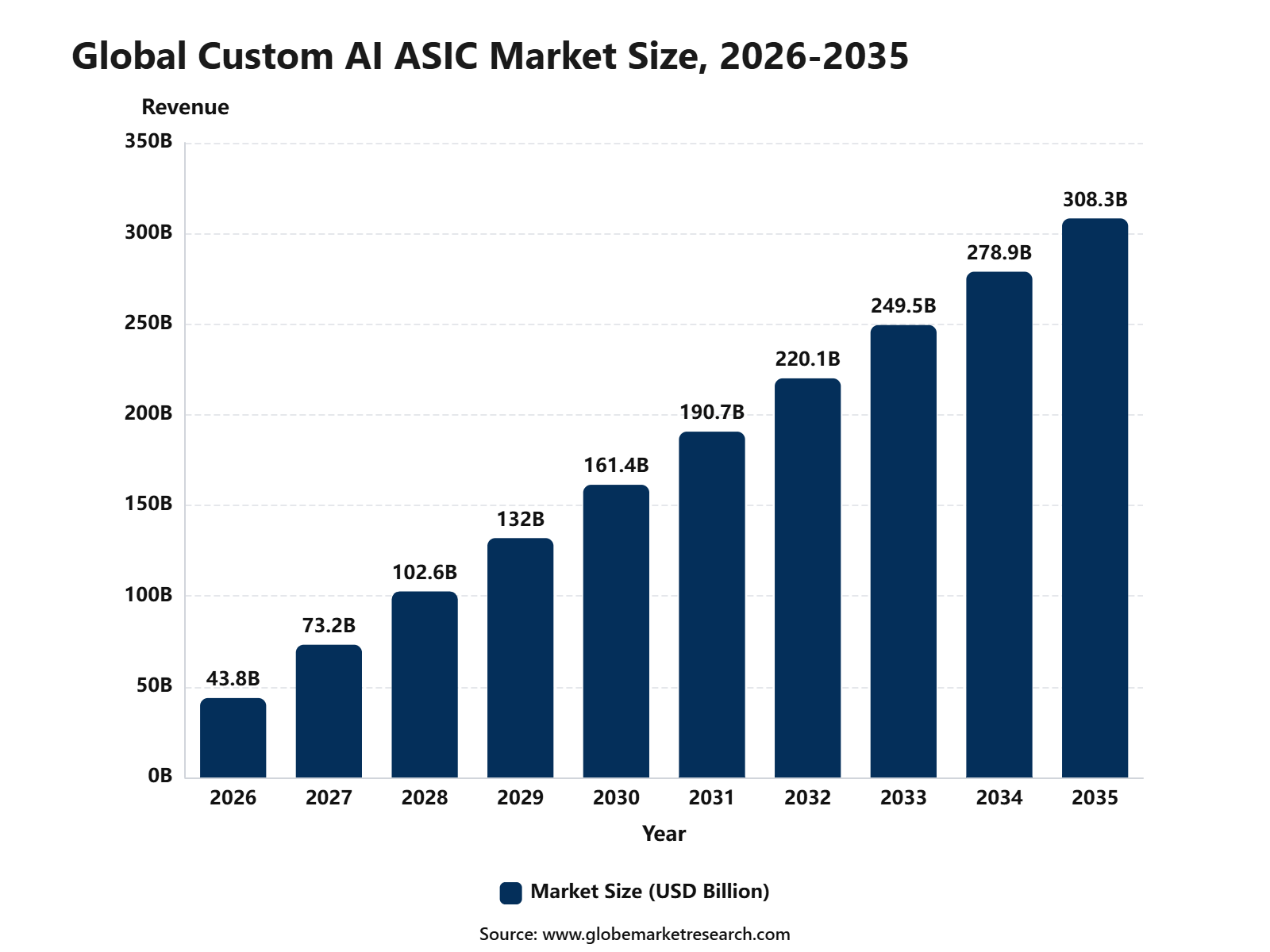
Custom AI ASIC Market Size
2026: The global Custom AI ASIC Market is valued at USD 43.8 billion.
2027: The market is projected to reach USD 73.2 billion, driven by increasing demand for AI-specific chips.
2028: Market revenue is expected to increase to USD 102.6 billion, supported by growing AI infrastructure investments.
2029: The market is forecast to reach USD 132.0 billion, reflecting greater adoption of custom AI processors.
2030: Market size is projected to reach USD 161.4 billion, supported by demand for high-performance AI computing.
2031: The market is expected to grow to USD 190.7 billion, driven by expanding AI inference workloads.
2032: Global market revenue is forecast to reach USD 220.1 billion, supported by AI data center expansion.
2033: The market is projected to increase to USD 249.5 billion, reflecting continued investment in custom semiconductor designs.
2034: Market revenue is expected to reach USD 278.9 billion, supported by increasing deployment of AI accelerators.
2035: The global Custom AI ASIC Market is forecast to reach USD 308.3 billion, driven by sustained demand for specialized AI computing solutions.
Latest Developments
January 26, 2026: Microsoft introduced Maia 200 for AI inference.
Microsoft announced its second-generation Maia accelerator using TSMC's 3-nanometer manufacturing technology. The processor was deployed in the US Central Azure region, with US West 3 identified as the next deployment location. The launch strengthened Microsoft's efforts to integrate its own silicon into cloud AI services.
March 11, 2026: Meta announced four additional MTIA generations.
Meta presented MTIA 300, 400, 450, and 500, with deployment plans extending through 2027. The architectures target recommendation model training, content ranking, and generative AI inference. Meta also described a development approach capable of introducing new chip designs approximately every six months.
April 14, 2026: Broadcom and Meta expanded their custom silicon partnership.
The companies announced a multiyear agreement covering several generations of MTIA accelerators, including a planned 2-nanometer accelerator. The collaboration includes advanced Ethernet technologies to connect large groups of AI processors. It demonstrates how hyperscale companies increasingly work with external semiconductor design partners.
April 22, 2026: Google introduced TPU 8t and TPU 8i.
Google announced two specialized versions of its eighth-generation AI processor architecture. TPU 8t focuses on large-scale AI training, while TPU 8i targets inference workloads. This separates processor designs according to different computational requirements.
July 15, 2026: India approved Semicon 2.0.
India's government approved a new semiconductor development program covering chip design, manufacturing equipment, advanced packaging, research, and workforce development. The program includes support for emerging semiconductor businesses, although it is not restricted to custom AI chips.
August 24, 2026: Meta published MTIA 300 networking performance results.
The company described its use of integrated network interface chiplets and dedicated communication engines. Its design incorporates networking directly into the accelerator package rather than relying entirely on separate networking devices. The architecture aims to reduce communication bottlenecks in distributed AI workloads.
October 14, 2026: GlobalFoundries announced a U.S.- Japan manufacturing initiative.
GlobalFoundries was selected to operate two proposed semiconductor fabrication facilities in Malta, New York. The initiative provides for up to USD 21 billion in funding and targets foundational semiconductor capacity. This is a wider supply-chain development rather than a dedicated advanced AI ASIC fabrication project.
October 15, 2026: TSMC reported strong advanced-node manufacturing demand.
TSMC's third-quarter earnings showed growth in leading-edge wafer manufacturing and confirmed continued expansion of its 2-nanometer production. The company also issued stronger fourth-quarter revenue guidance. This is relevant to custom AI ASICs because many advanced accelerators rely on sophisticated semiconductor fabrication and packaging capabilities.
Custom AI ASIC Market and Industry Statistics
Global semiconductor revenue and AI infrastructure demand
Custom AI ASIC demand is increasingly visible in semiconductor supplier results, even though most companies do not report separate revenue for these processors. Broadcom's disclosures provide one of the clearest financial indicators of demand for specialized AI accelerators. Semiconductor foundry performance, cloud infrastructure revenue, and advanced chip manufacturing activity provide additional context, but should not be combined into a single ASIC market estimate.
- USD 20.84 billion: Broadcom's semiconductor solutions segment revenue in fiscal Q3 2026, representing 70% of its total corporate revenue. The segment includes products beyond AI chips.
- USD 13.67 billion: Broadcom's reported free cash flow for fiscal Q3 2026, an increase of 95% over the corresponding prior-year quarter.
- 46%: Year-over-year growth in Marvell's data center portfolio during fiscal Q2 2027, supported by demand for networking and custom semiconductor technologies.
- 50.9%: TSMC's Q3 2026 year-over-year consolidated revenue increase when measured in New Taiwan dollars.
- 33%: The contribution of 3-nanometer manufacturing technology to TSMC's wafer revenue in Q3 2026.
- 28%: TSMC's 5-nanometer share of wafer revenue during the same quarter, illustrating continued demand for advanced manufacturing processes.
- USD 403.3 billion: Worldwide semiconductor sales during Q2 2026, representing a 35.1% increase from the first quarter under the industry's reported methodology.
- USD 159.7 billion: Global semiconductor sales in August 2026, reported as a three-month moving average, up 8% from July under the same reporting series.
- USD 24.8 billion: Google Cloud revenue in Q2 2026, increasing 82% year over year. This reflects the wider cloud business, including enterprise AI infrastructure and services.
- USD 42.2 billion: AWS net sales in Q2 2026, increasing 37% annually as Amazon expanded its cloud infrastructure business.
- NT$511.86 billion: TSMC's consolidated September 2026 revenue, representing 54.6% annual growth.
Industry financial performance comparison
The following table uses comparable reporting periods within each company. It does not imply that the companies have identical business models or that their total revenue represents custom AI ASIC sales.
| Company | Financial measure | 2025 | 2026 |
|---|---|---|---|
| Broadcom | Q3 total revenue, USD Bn | 15.95 | 29.59 |
| TSMC | Q3 total revenue, NT$ Bn | 989.92 | 1,494.24 |
| Meta | Q3 total revenue, USD Bn | 51.24 | 64.60 |
| Alphabet | Q2 total revenue, USD Bn | Approx. 96.4 | 119.8 |
Analyst interpretation
Three measurable developments stand out. First, specialist semiconductor suppliers are experiencing stronger demand for AI-oriented products. Second, cloud platforms are committing resources to increasingly customized accelerator architectures. Third, advanced semiconductor fabrication is becoming an important factor in AI infrastructure planning.
However, rising revenue at cloud providers cannot be interpreted as equivalent growth in custom ASIC sales. GPU-based infrastructure, networking devices, memory, storage, and software services also contribute to reported financial performance.
Regional Custom AI ASIC Statistics
Which regions are expanding semiconductor and AI computing activity?
North America remains a major center for custom AI processor design and cloud deployment, while Taiwan plays a central role in advanced chip fabrication. Asia Pacific also contains important semiconductor manufacturing, assembly, and design ecosystems. Europe and emerging economies are expanding semiconductor development programs, although publicly reported custom AI ASIC consumption statistics remain limited.
Regional comparison table
| Region | Latest verified statistic | Reporting year | Key insight |
|---|---|---|---|
| Americas | Semiconductor sales increased 180.9% year over year in August | 2026 | Strong growth in regional semiconductor sales |
| Asia Pacific and Other | Semiconductor sales increased 143.0% year over year in August | 2026 | Major semiconductor demand and manufacturing ecosystem |
| China | Semiconductor sales increased 131.3% year over year in August | 2026 | Significant growth in a separately reported sales region |
| Europe | Semiconductor sales increased 98.5% year over year in August | 2026 | Growth across the wider European semiconductor market |
| Japan | Semiconductor sales increased 62.3% year over year in August | 2026 | Increasing semiconductor sales activity |
| Taiwan | TSMC reported a Q3 gross margin of 66.4% | 2026 | Advanced foundry profitability and manufacturing activity |
| India | 24 semiconductor design projects were approved for financial support | 2026 | Expanding domestic chip design capacity |
| European Union | More than €43 billion in public investment is envisaged under the Chips Act | Policy framework to 2030 | Continued public support for semiconductor capacity |
| United States and Japan | Up to USD 21 billion in funding announced for two U.S. fabrication facilities | 2026 | Cross-border semiconductor manufacturing investment |
Regional sales changes apply to all semiconductor categories, not only AI ASICs. The Americas, Asia Pacific and Other, China, Europe, and Japan follow the reporting association's classifications. Policy funding and manufacturing metrics are different measures and should not be ranked against sales growth.
North America
The United States hosts major organizations developing custom AI processors, including Alphabet, Amazon, Microsoft, and Meta. Their hardware strategies combine proprietary accelerators with commercial computing products, cloud infrastructure, and specialized software.
North America also benefits from semiconductor design expertise and expanding investment in chip production. However, there is no comparable public dataset establishing the region's precise share of worldwide custom AI ASIC revenues in 2026.
Asia Pacific
Taiwan's manufacturing capabilities remain important for high-performance AI chip production. TSMC is directly involved in manufacturing advanced processors used by major technology companies. India is developing its semiconductor ecosystem through fabrication, packaging, and design initiatives.
South Korea, Japan, and China also participate in essential parts of the wider semiconductor supply chain, including memory, materials, components, and equipment. Their individual contributions to custom AI ASIC manufacturing cannot be reliably expressed as comparable market shares from the reviewed public data.
Europe
The European semiconductor strategy emphasizes domestic production capacity, research, industrial supply chains, and technological independence. The European Commission published a Chips Act 2.0 proposal on June 3, 2026, aimed at strengthening manufacturing and reducing dependency on external suppliers.
These measures may support European AI hardware development. However, the available policy figures cover the wider semiconductor industry rather than a dedicated custom AI ASIC segment.
Latin America and the Middle East and Africa
Reliable 2026 statistics isolating custom AI ASIC adoption in Latin America, the Middle East, or Africa were not identified in the reviewed primary disclosures. Semiconductor demand in these regions cannot be accurately determined by allocating a portion of the global market based on population, GDP, or general AI adoption.
Saudi Arabia established HUMAIN in May 2025 to develop AI infrastructure, cloud platforms, and related technologies. Its infrastructure plans illustrate growing interest in regional AI computing capacity, but do not establish a verified regional custom ASIC market value.
Custom AI ASIC Adoption and Usage Statistics
How widely are custom AI ASICs being deployed?
Custom AI ASIC adoption is most clearly documented among major cloud providers, AI model developers, and large technology companies. These organizations either deploy their own processors or purchase computing capacity supported by specialized chips. Public information is less complete for individual enterprises that consume custom ASIC capacity through managed cloud services.
Top adoption and deployment statistics
More than 1 million Trainium2 chips: Anthropic confirmed on April 20, 2026, that it was using more than one million AWS Trainium2 processors to train and serve Claude models.
1.4 million Trainium2 chips landed: Amazon's February 2026 financial release reported this cumulative deployment-related measure and stated that Trainium2 supply was fully subscribed.
More than 500,000 chips in Project Rainier: Amazon's early-2026 disclosure reported this deployment scale for its operational custom AI computing cluster.
More than 100,000 Claude customers on AWS: Anthropic reported this customer count in April 2026. It measures organizations using Claude on Amazon Bedrock, not the number directly purchasing ASIC computing capacity.
MTIA 300 in production: Meta confirmed in March 2026 that its accelerator for training recommendation and ranking models had entered production.
Two identified U.S. Azure regions: Microsoft confirmed Maia 200 deployment in US Central and identified US West 3 as the next planned region in January 2026.
9,216 chips in an Ironwood TPU Pod: Google's published TPU7x technical specifications document this supported system configuration. It represents a hardware configuration, not worldwide installed units.
More than 375 high-volume Google Cloud customers: In May 2026, Google reported that each of these customers had processed more than one trillion AI tokens over the preceding 12 months. Their precise hardware mix was not disclosed.
More than 8.5 million monthly AI model developers: Google reported this figure in 2026 for developers building applications using its AI models. It is a measure of software ecosystem activity, not unique TPU hardware users.
100,000-plus companies using Amazon Bedrock: Amazon's early-2026 results referred to this scale while discussing its Trainium-based inference infrastructure. The figure measures Bedrock customers rather than companies that own Trainium chips.
Understanding the differences in adoption statistics
| Metric | What it measures | What it does not establish |
|---|---|---|
| Deployed accelerators | Physical chips installed or operating | Number of separate customers |
| Cloud customers | Organizations using a cloud service | Exclusive use of ASIC hardware |
| AI tokens processed | Volume of model computation | Number of processors or users |
| Production workloads | Applications operating on hardware | Total addressable market |
| Supported chip configurations | Technical capacity of a system | Actual worldwide installations |
| Announced deployments | Planned or committed deployment | Completed installation |
Enterprise Custom AI ASIC Adoption Statistics
How are large companies using custom AI ASICs?
Enterprise adoption is concentrated in workloads requiring high computing capacity, predictable performance, and sustained operational usage. AI model developers, cloud providers, and large digital platforms provide the strongest publicly documented examples. Custom chip adoption is often supported by direct collaboration between hardware designers and the organizations running AI workloads.
- Up to 5 gigawatts of computing capacity: Anthropic's April 2026 agreement with Amazon covers future capacity for training and deploying Claude, including multiple Trainium generations. This is a capacity commitment, not installed electricity demand.
- More than USD 10 billion in combined annualized revenue run rate: Amazon reported this measure for Trainium and Graviton together in its financial results released in February 2026. Graviton is a custom CPU family, so the figure is not exclusively AI ASIC revenue.
- 30% better performance per dollar: Microsoft reported this improvement for Maia 200 compared with the latest-generation hardware in its own deployment fleet. This is an internal company comparison, not an independently standardized industry benchmark.
- 79% of Marvell's quarterly revenue: Data center products represented this proportion of company sales in fiscal Q2 2027, indicating Marvell's increasing concentration in data center markets.
- USD 8.81 billion in Google Cloud operating income: Alphabet reported this result for Q2 2026, compared with USD 2.83 billion in the prior-year quarter. These figures reflect the full cloud segment rather than TPU-specific profitability.
- 10% higher advertising impressions: Meta reported this annual increase for Q3 2026 across its Family of Apps. Its custom silicon supports parts of the recommendation infrastructure, but the financial release does not attribute this increase specifically to MTIA.
- A 150-billion-parameter production recommendation model: Meta disclosed the model scale used in its MTIA 300 communication performance comparison. This provides evidence of a specific enterprise workload evaluated on custom hardware.
Small and Medium Enterprise Statistics
Are startups and SMEs adopting custom AI ASICs?
Public evidence of SMEs designing semiconductor chips is stronger than evidence of small businesses directly purchasing custom AI accelerators. Most smaller AI developers are more likely to access specialized computing resources through cloud services, technology partnerships, or research programs. A representative worldwide SME adoption percentage for custom AI ASICs is not currently available from the reviewed sources.
Key SME and startup findings
- 105 startups and MSMEs: India reported that this number had received support for accessing industry-standard electronic design automation tools under its semiconductor design program in 2026.
- 20 semiconductor startups: A September 2026 government statement reported that this number of startups had secured venture capital funding under the wider supported ecosystem.
- USD 10 million: Indian semiconductor design company Vervesemi Microelectronics announced a Series A funding round in February 2026. Its disclosed products focus on controllers and data-acquisition chips rather than AI accelerators.
- Up to USD 350,000 in cloud credits: Google described this support for eligible AI startups in its 2026 program. These credits apply to cloud services broadly and do not indicate a dedicated TPU subsidy of the same value.
- 100 participating AI startups: Google's October 2026 Gemini Startup Forum announcement described a cohort of 100 companies receiving access to technical support and business development resources.
- 254 semiconductor designs taped out: India's Chips to Start-ups program reported this cumulative achievement in August 2026. A tape-out means a completed design has been submitted for fabrication and does not necessarily mean commercial production.
SME adoption barriers and opportunities
For small businesses, custom chip development can require specialized engineers, design software, fabrication access, verification services, and significant financial resources. Cloud access can reduce the need to own physical accelerators, although recurring computing charges remain important.
Government-supported design tools, startup funding, and cloud credits can help smaller organizations participate in semiconductor development. However, the available figures do not establish how many SMEs operate profitable ASIC-based services or how much they spend on specialized processors.
Custom AI ASIC Technology and Innovation Statistics
Key processor performance and infrastructure statistics
| Technology | Verified technical metric | Reporting period |
|---|---|---|
| Microsoft Maia 200 | 216 GB HBM3e memory | January 2026 |
| Microsoft Maia 200 | 7 TB/s memory bandwidth | January 2026 |
| Microsoft Maia 200 | 750 W chip thermal design power | January 2026 |
| AWS Trainium3 | 144 GB HBM3e per chip | December 2025 specifications |
| AWS Trainium3 | 4.9 TB/s memory bandwidth per chip | December 2025 specifications |
| Google TPU 8t | 2 PB of shared memory in a superpod | April 2026 |
| Google Ironwood TPU7x | 2,307 BF16 TFLOPS per chip | Published technical documentation |
| Meta MTIA 300 | 1.2 TB/s integrated I/O bandwidth | August 2026 |
| Meta MTIA 300 | 16 dedicated communication engines | August 2026 |
| Meta MTIA 500 | Up to 80% more HBM capacity than MTIA 450 | March 2026 announced design |
Important areas of innovation
Advanced semiconductor manufacturing: Specialized AI processors increasingly use advanced manufacturing nodes to improve transistor density and computing efficiency. Smaller manufacturing nodes do not automatically produce proportional performance improvements because chip architecture, yield, memory systems, and packaging also affect results.
High-bandwidth memory: Modern AI workloads require rapid access to large amounts of data. Memory capacity and bandwidth influence how efficiently processors execute model training and inference operations. The growing use of integrated HBM highlights the importance of memory subsystem design alongside computing performance.
Chiplet architectures: Multiple smaller semiconductor components can be integrated into one advanced package. This approach allows computing, networking, and system-management functions to be developed as specialized building blocks. It can also provide greater flexibility for future processor generations.
Low-precision computing: AI accelerators increasingly support FP8, FP4, and other reduced-precision data formats. These techniques can increase useful computational throughput and reduce memory requirements when model accuracy is maintained. However, performance figures measured at different numerical precisions should not be compared without appropriate adjustments.
Software compatibility: Google, Microsoft, AWS, and Meta are investing in software integration to improve access to custom processors. Framework support and developer tools remain critical because the economic benefits of a processor may be reduced by difficult model migration or additional engineering requirements.
Custom AI ASIC Investment and Funding Statistics
How much capital is being invested?
Capital investment in custom AI ASICs is difficult to isolate because semiconductor development is often financed as part of broader cloud infrastructure, advanced manufacturing, or corporate research expenditure. Several major companies nevertheless disclose spending plans and commitments directly relevant to the infrastructure supporting custom processors.
Investment and expenditure comparison
| Company or initiative | Amount | Financial status | Reporting period |
|---|---|---|---|
| Alphabet | USD 180–190 Bn | Projected 2026 capital expenditure | June 2026 guidance |
| Meta | USD 135–145 Bn | Projected 2026 capital expenditure | October 2026 guidance |
| Microsoft | USD 41 Bn | Reported quarterly capital expenditure | Fiscal Q4 2026 |
| Alphabet | USD 80.6 Bn | Reported first-half capital expenditure | H1 2026 |
| Meta | USD 34.91 Bn | Reported quarterly capital expenditure, including finance lease principal | Q3 2026 |
| Anthropic and AWS | More than USD 100 Bn | Multiyear technology spending commitment over 10 years | April 2026 |
| Amazon investment in Anthropic | USD 5 Bn | Announced additional investment | April 2026 |
| Amazon investment in Anthropic | Up to USD 20 Bn | Potential additional future investment | April 2026 |
| India's Semicon 2.0 | ₹1,27,500 crore | Approved government program budget | July 2026 |
| European Chips Act | More than EUR 100 Bn | Public and private policy-driven investment framework through 2030 | Existing policy framework |
Three important investment patterns
1. Cloud infrastructure accounts for substantial capital requirements.
Large cloud providers are financing custom processor design alongside data center construction, networking, storage, and power infrastructure. Custom AI ASICs represent one component of broader infrastructure programs rather than the full amount of capital spending.
2. Long-term computing contracts are becoming important.
Large AI developers are entering long-duration agreements to secure computing capacity. These arrangements can support investment planning for chip manufacturers and cloud providers, but announced contract values should not be confused with completed purchases or annual semiconductor revenue.
3. Public investment is expanding semiconductor capacity.
Governments are financing semiconductor manufacturing, research, design, and advanced packaging. These programs can improve industrial capacity over time, although announced budgets do not necessarily translate immediately into operating semiconductor facilities.
Leading Companies and Performance Statistics
The following companies are included because of their documented involvement in custom AI accelerator design, deployment, semiconductor manufacturing, or supporting technology. The table does not represent a market-share ranking.
| Company | Role in the custom AI ASIC industry | Verified performance or operating indicator |
|---|---|---|
| Broadcom | Custom accelerator design and AI networking | AI semiconductor revenue increased 54% sequentially in fiscal Q3 2026 |
| Marvell Technology | Custom silicon, interconnects, and data infrastructure | Data center revenue reached USD 2.17 Bn in fiscal Q2 2027 |
| TSMC | Advanced semiconductor fabrication | Advanced processes of 7 nm and below represented 79% of Q3 2026 wafer revenue |
| Amazon Web Services | Trainium accelerator development and deployment | Trainium4 is expected to begin delivery in 2027 |
| Alphabet | Google TPU design and cloud deployment | TPU 8t provides nearly 3 times the stated computing performance of its preceding generation |
| Microsoft | Maia AI accelerator development | Maia 200 supports clusters of up to 6,144 accelerators |
| Meta Platforms | MTIA accelerator development and deployment | MTIA 450 was scheduled for mass deployment in early 2027 |
| GlobalFoundries | Semiconductor manufacturing and advanced packaging | Selected as operator of two planned U.S. fabrication facilities in October 2026 |
Company disclosures and product announcements. Revenue metrics use company-specific reporting periods; architectural figures reflect stated product capabilities or future plans.
Top Companies with Highest Market Share
Verified, methodologically comparable company-level shares of the global custom AI ASIC market are not publicly disclosed in the sources reviewed for 2026. Broadcom's reported AI semiconductor revenue and Marvell's data center revenue cannot be directly converted into individual custom ASIC market shares because their reporting segments include additional products and services.
Competitive landscape analysis
Custom AI ASIC development generally follows two business models. In the first, technology companies design processors for internal deployment, as demonstrated by Google, Microsoft, AWS, and Meta. In the second, semiconductor suppliers collaborate with large customers to develop and manufacture specialized accelerator designs.
These models are supported by fabrication providers, memory suppliers, advanced packaging companies, and networking technology businesses. Competition therefore involves more than processor speed. Manufacturing access, software compatibility, cost efficiency, reliability, and the ability to support large deployments also influence commercial performance.
13. Consumer and User Behavior Statistics
How does consumer AI usage affect demand for custom AI ASICs?
Consumers generally use AI applications without knowing which semiconductor processors support them. Their choices are typically influenced by application features, availability, response quality, and cost rather than whether a provider uses TPUs, GPUs, or proprietary ASICs. Consumer AI usage can help explain demand for computing infrastructure, but application usage figures should not be treated as measurements of custom ASIC adoption.
Consumer AI usage findings
- More than 1 billion monthly Gemini app users: Google announced this milestone on August 11, 2026, showing the scale of consumer demand for its AI application.
- 63% of Gemini users used voice interactions: Google's August 2026 product update reported this behavior. The company did not provide a representative survey methodology in the announcement.
- One in five Gemini Live interactions involved more than voice: Google identified camera and screen-sharing capabilities as examples of multimodal usage.
- 38% of school-related Gemini requests included an attachment: The company reported this measure as an indication of how students use multimodal capabilities.
- More than 150 million images generated daily: Google reported this output level for Gemini's image creation features in August 2026.
- More than 100 million active Gemini users on iOS: Google disclosed this platform-specific figure during August 2026.
- 3.64 billion daily active people: Meta's Family of Apps reached this average during September 2026. This represents people using its social applications, not people knowingly using custom AI chips.
- More than 2.5 billion monthly AI Overviews users: Google disclosed this figure in 2026, demonstrating the scale of AI-supported search experiences.
Implications for custom AI hardware
Consumer demand is increasingly associated with text generation, image creation, voice interaction, and multimodal applications. These services have different memory, networking, and response-time requirements. Custom AI ASIC development is consequently influenced by the applications that providers expect to operate at scale. However, no reliable public consumer survey establishes a preference for ASIC-based services over otherwise comparable GPU-based services.
Challenges and Risk Statistics
What are the main challenges facing custom AI ASIC adoption?
Custom AI ASIC development requires substantial investment in design, manufacturing, memory, packaging, and supporting infrastructure. Although specialized chips can improve performance for defined workloads, the benefits depend on software compatibility, deployment scale, utilization, and operating costs.
Key challenges supported by industry data
- Rising electricity consumption: Global data center electricity demand was estimated at 485 TWh in 2025, according to an energy analysis published in April 2026. This includes all data center workloads, not only custom AI ASICs.
- Greater future power requirements: The same analysis projects approximately 950 TWh of worldwide data center electricity consumption in 2030 under its central scenario. This projection remains dependent on infrastructure deployment and efficiency improvements.
- Growing AI infrastructure capital requirements: Capital expenditure by five major technology companies exceeded USD 400 billion in 2025 and was projected in the April 2026 analysis to increase by another 75% during 2026. The total covers broader technology infrastructure.
- Semiconductor workforce shortages: A semiconductor industry study published in 2023 projected approximately 67,000 unfilled technical positions in the United States by 2030 under existing workforce development conditions. This forecast concerns the wider semiconductor workforce, including chip design and manufacturing.
- Higher system complexity: The September 2026 MLPerf Inference round included 16 multi-node submissions, reflecting increased interest in larger distributed AI systems. Communication efficiency and system integration become more important as accelerator counts increase.
- Geographic infrastructure concentration: An international energy assessment published in 2025 reported that nearly half of U.S. data center capacity was concentrated in five regional clusters. Concentration can increase pressure on local electricity infrastructure and supporting services.
- Limited deployment transparency: Public disclosures from major ASIC developers generally describe individual processor deployments and selected performance measurements rather than standardized worldwide shipment totals. Consequently, independently comparable ASIC adoption rates and market shares cannot be calculated reliably from these disclosures.
Future Outlook and Custom AI ASIC Trends
What will shape the custom AI ASIC industry after 2026?
The outlook for custom AI ASICs depends on the relationship between AI computing demand, processor specialization, manufacturing capacity, and total operating costs. Official company roadmaps support several identifiable developments, although the pace of commercial adoption remains uncertain.
1. Greater specialization between training and inference
AI processor developers are introducing architectures optimized for different operational requirements. Training workloads emphasize large-scale computation and communication between processors, while inference workloads often prioritize latency, memory bandwidth, and serving costs.
This separation could encourage cloud providers to operate a broader portfolio of specialized accelerators rather than relying on one processor design for every AI task.
2. Wider use of custom processors in cloud platforms
AWS, Google, Microsoft, and Meta have established multigeneration custom silicon programs. Their continued development efforts indicate that proprietary processors are becoming a long-term infrastructure consideration rather than an isolated product experiment.
However, general-purpose accelerators are expected to remain important, particularly for workloads requiring flexibility, broad software compatibility, or rapid experimentation.
3. Increasing importance of memory systems
AI applications with long context windows, large models, and complex inference workloads place significant demands on memory capacity and data movement. Future accelerator designs are likely to place additional emphasis on integrated memory, interconnect bandwidth, and efficient data reuse. The practical benefit will depend on model architecture and workload utilization.
Frequently Asked Questions About Custom AI ASICs
1. How big is the custom AI ASIC market in 2026?
A reliable global market-size figure specifically covering custom AI ASICs in 2026 is not available from the reviewed primary disclosures. Companies commonly report broader AI semiconductor revenue, including networking and other products. These financial results demonstrate commercial activity but cannot be aggregated into a precise custom ASIC market value without additional product-level information.
2. What are the latest custom AI ASIC statistics for 2026?
The strongest verified statistics concern accelerator deployment, manufacturing activity, and supplier revenue. Major developments include large Trainium deployments, new TPU and Maia architectures, and expanded MTIA production. They demonstrate increasing use of specialized AI hardware, although companies apply different reporting definitions and generally do not disclose complete worldwide ASIC shipment totals.
3. Which companies are developing custom AI ASICs?
Major organizations with documented custom AI accelerator programs include Google, Amazon Web Services, Microsoft, and Meta. Broadcom and Marvell also provide custom silicon development capabilities and related semiconductor technologies. TSMC is an important manufacturing partner. Their business models differ, with some companies designing chips for internal deployment and others supplying external customers.
4. What is the difference between a custom AI ASIC and a GPU?
A custom AI ASIC is developed around particular computing requirements, while a GPU generally supports a wider range of programmable parallel workloads. ASICs may provide better efficiency for applications closely matched to their architectures. GPUs can offer greater flexibility and software portability. Actual advantages depend on the AI model, deployment environment, and available software tools.
5. What percentage of enterprises use custom AI ASICs?
A verified worldwide percentage of enterprises using custom AI ASICs was not identified for 2026. Organizations may access ASIC-based computing through cloud platforms without knowing or selecting the underlying hardware. Existing AI adoption surveys therefore cannot establish direct ASIC adoption unless they specifically ask respondents about processor architecture and deployment.
6. Which country leads in custom AI ASIC development?
The United States is an important center of custom AI accelerator design because several major developers and cloud providers operate there. Taiwan plays a major role in advanced semiconductor manufacturing. However, a definitive country ranking for custom AI ASIC revenue or installed chips cannot be established without comparable country-level figures covering the same market definition.
7. How much investment is going into custom AI ASICs?
Custom AI ASIC investment is included within broader spending on cloud infrastructure, semiconductor manufacturing, and research. Public company budgets and technology agreements show substantial financial commitments, but they do not consistently disclose the portion spent exclusively on custom AI processors. As a result, a verified global ASIC-specific investment total is not available for 2026.
8. Which industries use custom AI ASICs the most?
The clearest documented deployments are found in cloud computing, large AI model development, online advertising, recommendation systems, and digital services. Major technology companies operate these systems at substantial scale. Reliable comparisons of ASIC adoption across healthcare, manufacturing, finance, retail, and other industries remain limited because cloud customers rarely report their underlying processor mix.
9. Are custom AI ASICs cheaper than GPUs?
Custom AI ASICs can offer lower computing costs for specific workloads, but they are not universally cheaper than GPUs. Development costs, model compatibility, processor utilization, memory requirements, and deployment size influence the final comparison. Organizations should evaluate complete system costs and the cost of useful AI output rather than relying solely on chip prices or theoretical performance.
10. Are custom AI ASICs used for training or inference?
Custom AI ASICs are used for both AI training and inference. Training involves developing a model, while inference involves using a trained model to produce predictions or responses. Some processors are designed primarily for one task, while others support several workloads. Processor specialization is becoming more pronounced as infrastructure requirements become more complex.
11. What are the biggest challenges for custom AI ASIC manufacturers?
Major challenges include advanced semiconductor fabrication requirements, memory supply, packaging capacity, software compatibility, and substantial development costs. Manufacturing delays and changing AI model architectures can also affect commercial performance. For organizations deploying the chips, electricity availability, cooling requirements, reliability, and cost per completed task are important operational concerns.
12. What is the future of custom AI ASIC technology?
Custom AI ASIC development is likely to focus on more specialized training and inference designs, advanced memory systems, chiplet integration, and improved energy efficiency. Cloud providers are expected to continue evaluating proprietary accelerators alongside commercial processors. The pace of adoption will depend on proven cost advantages, software support, manufacturing availability, and sustained AI computing demand.
Conclusion
Custom AI ASIC statistics for 2026 demonstrate that specialized semiconductor processors have become an important component of large-scale artificial intelligence infrastructure. The strongest evidence comes from operating chip deployments, official accelerator specifications, semiconductor supplier results, and manufacturing disclosures. Developments across Trainium, TPU, Maia, and MTIA illustrate how large technology companies are adapting processor architectures to their computing requirements.
The industry nevertheless faces important measurement limitations. Public companies often combine custom accelerator revenue with other semiconductor products, while cloud users rarely disclose the specific processors supporting their applications. Consequently, market-size estimates, company market shares, and worldwide enterprise adoption percentages should not be presented as established facts without independently comparable data.
For business leaders and investors, the main consideration is whether specialized hardware can deliver measurable advantages under real operating conditions. For researchers and policymakers, attention should also be directed toward semiconductor manufacturing capacity, software accessibility, electricity requirements, and workforce development. Continued investment is likely to support further technical progress, but commercial success will depend on the reliability, efficiency, and economic performance of custom AI computing systems.
Reference Sources
- https://investors.broadcom.com/news-releases/news-release-details/broad…
- https://blogs.microsoft.com/blog/2026/01/26/maia-200-the-ai-accelerator…
- https://www.semiconductors.org/year-to-date-global-semiconductor-sales-…
- https://www.pib.gov.in/PressReleasePage.aspx?PRID=2284796&lang=1®=3
- https://pr.tsmc.com/english/news/3346
- https://about.fb.com/news/2026/03/expanding-metas-custom-silicon-to-pow…
- https://cloud.google.com/blog/products/compute/ai-infrastructure-at-nex…
- Log in to post comments