
What Is AI Observability?
AI observability is the practice of continuously monitoring, analyzing, and understanding the behavior, performance, reliability, and decision-making processes of artificial intelligence systems throughout their operational lifecycle. It combines model monitoring, data quality assessment, distributed tracing, output evaluation, performance metrics, and governance tools to identify problems in AI applications before they negatively affect business operations or customer experiences.
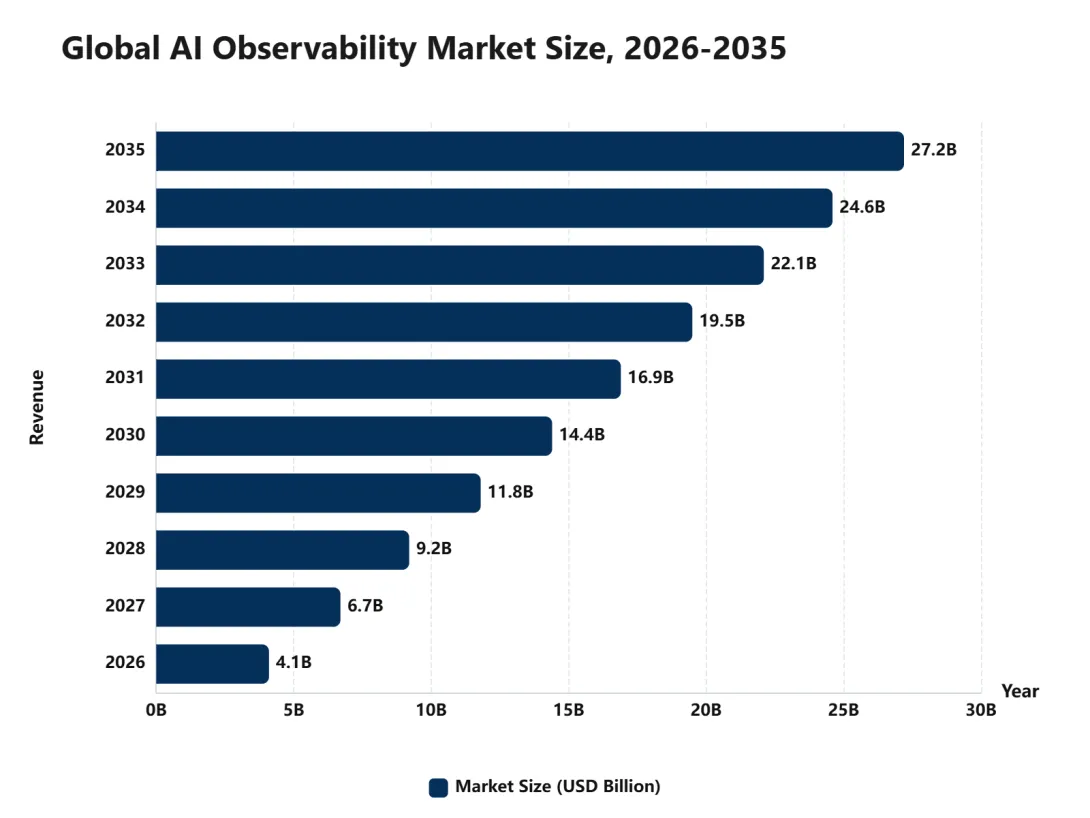
The global AI Observability Market is estimated to reach USD 4.1 billion in 2026 and is projected to expand to approximately USD 27.2 billion by 2035, registering a CAGR of 23.4% from 2026 to 2035. North America is estimated to dominate the market with a 40.2% share in 2026, representing approximately USD 1.65 billion.
Request a Sample Copy @ sales@insightmarkresearch.com
Dominating Segments
| Segment | Dominating Segment | Market Share, 2026 (%) | Market Insights |
|---|---|---|---|
| By Component | Platforms | 63.9% | Driven by demand for centralized AI performance monitoring and operational visibility. |
| By Deployment | Cloud-Based | 71.8% | Supported by scalability, continuous monitoring, and integration with cloud-based AI systems. |
| By Application | Model Monitoring | 35.5% | Driven by the need to detect model drift, performance degradation, and unexpected outputs. |
| By Enterprise Size | Large Enterprises | 49.3% | Supported by complex AI environments and increasing investments in AI governance. |
| By End-User Industry | BFSI | 30.4% | Driven by demand for reliable AI systems in fraud detection, risk assessment, and regulatory compliance. |
| By Region | North America | 40.2% | Supported by advanced AI infrastructure and strong enterprise adoption of observability platforms. |
AI Observability Statistics 2026
According to Dynatrace’s November 2026 research, 87% of surveyed technology leaders reported using AI agents for observability and IT operations. This measures AI-assisted monitoring and operations, rather than monitoring AI systems themselves.
The same enterprise survey found that humans verified an average of 66% of AI-powered decisions. Human oversight remained substantial despite growing interest in autonomous operations.
Business-impact findings in the report show that only 24% addressed measurement of AI behaviour’s business impact, while 39% considered it important. This represents a 15-percentage-point gap between perceived importance and implementation.
OpenTelemetry adoption results identify AI and LLM workload observability as a leading adoption driver for 37% of respondents. The finding highlights demand for consistent telemetry across AI applications and their supporting infrastructure.
LangChain’s 2026 State of Agent Engineering report found that 44.8% of respondents with production agents conducted online evaluations. These evaluations assess behaviour on live traffic, helping teams detect problems after deployment. The underlying survey was conducted in late 2025.
Evaluation-method findings from that survey report 53.3% adoption of LLM-as-judge approaches among organizations running evaluations. These methods use language models to assess outputs against criteria such as quality, factual accuracy and adherence to guidelines.
The report also records human review at 59.8% among organizations conducting evaluations. Teams combined manual assessment with automated methods to examine nuanced responses and situations requiring closer judgment.
Datadog’s March 2026 production telemetry recorded nearly 8.4 million rate-limit errors. These accounted for almost one-third of LLM call errors in the analysed dataset, illustrating the need to monitor provider limits and request volumes.
Request-level analysis in the same report found that average tokens per request more than doubled year over year for median customers and quadrupled for customers at the 90th percentile. Larger requests increase the importance of tracking context size, latency and inference costs.
The telemetry study found that 18% of end-to-end agentic application requests involved three or more service calls. These workflows require tracing across service boundaries to identify where delays, failures and unexpected behaviour occur.
Component Insights
Platforms accounted for 63.9% of the AI Observability Market by component. Observability platforms provide centralized visibility into model performance, prompts, traces, data pipelines, latency, token consumption, errors, drift and agent behavior. Their importance is increasing as organizations move from isolated AI models toward interconnected applications and autonomous agents operating across production environments.
Operational reliability is becoming a significant concern. Production data published in 2026 showed that nearly 1 in 20 AI requests fail, indicating that model intelligence alone is insufficient for reliable enterprise deployment. This strengthens demand for centralized platforms capable of monitoring errors, infrastructure bottlenecks and application behavior continuously.
| Component | Market Share, 2025 (%) |
|---|---|
| Platform | 63.9% |
| Services | 36.1% |
Deployment Insights
Cloud-Based deployment represented 71.8% of the market. Cloud observability platforms provide scalable monitoring, centralized telemetry, continuous updates and easier integration with cloud-hosted models, APIs, databases and agent frameworks. This architecture is particularly suitable for enterprises operating AI workloads across multiple teams and geographic locations.
Cloud infrastructure is already central to agentic AI deployment. Recent enterprise research found that 63% of organizations test and deploy AI agents using public-cloud infrastructure, reinforcing the need for cloud-native observability systems capable of tracing models, agents and workloads across distributed environments.
| Deployment Mode | Market Share, 2025 (%) |
|---|---|
| Cloud-Based | 71.8% |
| On-Premises | 28.2% |
Application Insights
Model Monitoring accounted for 35.5% of the AI Observability Market by application. Model monitoring helps organizations identify performance degradation, drift, anomalous outputs, unexpected behavior and changes in model quality after deployment. Continuous monitoring is especially important for regulated and customer-facing AI systems where inaccurate results can create financial, compliance or reputational risks.
Monitoring is becoming a standard AI governance practice. A 2026 financial-services study found that 94% of participating institutions use ongoing AI performance monitoring, showing how continuous evaluation is becoming embedded in production AI management.
| Application | Market Share, 2025 (%) |
|---|---|
| Model Monitoring | 35.5% |
| Data Monitoring | 20.1% |
| Performance Monitoring | 16.7% |
| Explainability & Governance | 14.5% |
| Other Applications | 13.2% |
Enterprise Size Insights
Large Enterprises held a 49.3% share of the market by enterprise size. Large organizations typically operate broader AI portfolios across business units, cloud environments, third-party models, internal datasets and enterprise applications. This complexity increases requirements for model inventories, tracing, governance, incident detection and centralized observability.
Visibility gaps remain significant as deployments scale. A global study of technology executives published in 2026 found that 70% said business teams are deploying technology faster than IT can track it. This operational gap strengthens the need for enterprise-wide AI observability and control platforms.
| Enterprise Size | Market Share, 2025 (%) |
|---|---|
| Large Enterprises | 49.3% |
| Medium Enterprises | 29.4% |
| Small Enterprises | 21.3% |
End-User Industry Insights
BFSI accounted for 30.4% of the AI Observability Market by end-user industry. Banks, insurers, payment companies and investment firms increasingly use AI for fraud detection, credit assessment, customer operations, risk analysis, compliance and decision support. These applications require strong monitoring because inaccurate or unexplained AI decisions can directly affect customers and regulated financial activities.
AI adoption in financial services has reached a high level. In October 2026, a major financial-sector study reported that 86% of surveyed firms were using AI, up from 75% in 2024. Greater use of production AI increases requirements for model validation, explainability, performance monitoring and risk controls.
| End-User Industry | Market Share, 2025 (%) |
|---|---|
| BFSI | 30.4% |
| IT & Telecommunications | 16.2% |
| Healthcare | 13.6% |
| Retail & E-commerce | 11.8% |
| Manufacturing | 10.4% |
| Government | 9.2% |
| Other Industries | 8.4% |
Regional Insights
North America led the AI Observability Market with a 40.2% share in 2026, representing approximately USD 1.65 billion. Regional leadership is supported by strong enterprise AI adoption, major cloud providers, foundation-model developers, observability software companies and extensive deployment of AI across financial services, technology and professional services.
Large U.S. organizations are adopting AI at significantly higher rates than the overall business population. U.S. Census Bureau data published in 2026 showed that 37% of firms with 250 or more employees were already using AI in business operations. As these large deployments expand, demand for centralized monitoring, governance and AI reliability infrastructure is expected to increase.
| Region | Market Share, 2025 (%) |
|---|---|
| North America | 40.2% |
| Europe | 19.3% |
| Asia Pacific | 24.5% |
| Latin America | 8.8% |
| Middle East and Africa | 7.2% |
Core Technologies in the AI Observability Market
AI observability helps teams understand how predictive models, generative AI applications, and AI agents behave in production. It combines model monitoring, workflow tracing, and output evaluation to help teams identify where performance declined, why a task failed, or what drove an increase in cost.
| Core Technology | What It Tracks | Practical Example |
|---|---|---|
| Model Monitoring and Drift Detection | Changes in input data, prediction quality, and other measures relative to a baseline. | Flag a change in transaction patterns and check fraud detection accuracy once confirmed outcomes are available. |
| Model and Agent Tracing | The sequence and duration of model calls, document retrieval, and tool actions. | Identify whether a support agent stalled while retrieving a policy or querying an account system. |
| Output and Retrieval Evaluation | Whether an answer meets defined criteria and whether the system retrieved relevant evidence. | Check whether a policy assistant’s answer is supported by the approved source text. |
| Latency and Cost Monitoring | Response time, token usage, and model spending by request or workflow. | Identify repeated model calls that increase the cost of completing a document review. |
| Regression Testing | Changes in output quality and task performance after a model, prompt, or retrieval update. | Replay representative requests before a release to check whether the update introduces new failures. |
Key Use Cases and Industry Adoption
| Industry | Major AI Observability Use Cases |
|---|---|
| Banking and Insurance | Monitor fraud and risk models for changes in input data or prediction accuracy. Check whether customer assistants answer questions using approved product and policy documents. |
| Retail and E-Commerce | Trace product searches, inventory checks, and order status requests to identify slow or unsuccessful steps in shopping assistants. |
| Enterprise Customer Support | Review failed conversations to determine whether the agent retrieved the wrong article, misunderstood a request, or failed to complete an action. |
| Enterprise Software and IT | Track model spending and response times across copilots. Compare quality before and after changes to models, prompts, or retrieval systems. |
Key Vendors and Major Innovations in 2026
| Vendor and Offering | 2026 Development | Market Significance |
|---|---|---|
| ClickHouse and Langfuse | ClickHouse acquired Langfuse in January 2026. Langfuse introduced its AI Gateway in public beta in November 2026. | The gateway brings model call records and costs into one place, helping teams track usage across applications and agents. |
| Datadog Agent Observability | At DASH 2026, Datadog highlighted Patterns, a feature that groups production traces by behaviour, cost, and quality signals. | Teams can identify recurring failures across many interactions and use those cases to test fixes. |
| Arize AI Phoenix | The open source platform combines OpenTelemetry tracing, versioned evaluation datasets, and experiments for prompts, models, and retrieval. | Teams can turn examples of production failures into repeatable tests for future releases. |
OpenTelemetry is an important industry initiative. A November 2026 implementation example showed how shared generative AI conventions can record model calls and tool actions in a consistent format, making traces easier to interpret across applications and monitoring platforms.
Core Drivers & Challenges
Wider use of AI agents. As agents call multiple models and tools, teams need to trace each step to find where a workflow failed.
Greater focus on output quality. Businesses need to detect inaccurate answers, irrelevant responses and sensitive data exposure in production.
Pressure to control operating costs. Tracking token usage and response times helps teams identify which models and workflow steps drive costs and delays.
Fragmented telemetry. Differences in how providers record model and tool activity can make it difficult to reconstruct a single request.
Evaluation and privacy constraints. Automated quality scores need to be checked against human judgments. Capturing prompts and responses can also expose sensitive data and increase storage costs.
Key Capabilities & Trends
Model and data monitoring. Platforms track errors, changes in input data and declines in model performance after deployment.
End to end agent tracing. Platforms show how a request moves through model calls, document retrieval and external tools, helping teams pinpoint failures.
Continuous output evaluation. Teams assess samples of live responses for accuracy, relevance and safety, then use human feedback to refine evaluation criteria.
Cost and latency analysis. Dashboards show token usage and response times by model or workflow step, making it easier to identify bottlenecks.
Standardized telemetry. Common formats for recording model and tool activity make it easier to combine data across providers. Configurable capture lets teams control whether sensitive prompts and responses are recorded.
Acquisition Developments
Dynatrace acquires Arize: The transaction included approximately USD 815.9 million in cash at closing plus restricted equity awards valued at approximately USD 98.2 million when the agreement was executed. Arize AX remains available as an enterprise offering and Phoenix continues as an open-source project.
Cisco acquires Galileo: Completed on May 22, 2026, the transaction strengthens Splunk's capability to monitor the reliability, quality, safety, and behavior of AI agents throughout the development lifecycle. Financial terms were not disclosed.
ClickHouse acquires Langfuse: The January 2026 acquisition combines high-throughput analytical infrastructure with open-source LLM tracing, evaluation, and prompt management. Langfuse continues to operate as an open-source AI engineering platform.
ServiceNow acquires Traceloop: Traceloop's technology provides runtime tracing and evaluations for third-party AI agents and has been integrated into ServiceNow AI Control Tower. Its OpenLLMetry instrumentation work has also contributed to the wider open AI observability ecosystem.
OpenAI agrees to acquire Promptfoo: On March 9, 2026, OpenAI announced an agreement to acquire Promptfoo, a platform used for AI security testing and evaluation. Promptfoo provides capabilities covering agent evaluations, red teaming, prompt injection testing, data leakage detection, tool misuse, and compliance. OpenAI plans to integrate the technology into its Frontier enterprise platform while continuing the open-source project.
AI Observability Market Impact: Top 5 Trends
Agent observability is replacing simple LLM monitoring: Monitoring a single prompt and response is no longer sufficient for autonomous systems. Modern agents may retrieve information, select models, invoke APIs, call tools, communicate with other agents, retry tasks, and make decisions over long-running workflows. Platforms are therefore tracing complete agent trajectories, including reasoning steps, retrieval operations, tool calls, errors, latency, and outcomes.
Observability and AI evaluation are converging: Traditional observability asks whether a service is available and fast. AI observability must additionally determine whether the output was accurate, relevant, safe, grounded, compliant, and useful. Automated evaluations and LLM-as-a-judge techniques are consequently becoming core production monitoring functions.
OpenTelemetry is emerging as an important AI observability foundation: Vendors increasingly support OpenTelemetry-based collection so organizations can move AI traces between observability platforms without being tied to proprietary instrumentation. OpenInference is also being incorporated into the broader OpenTelemetry GenAI ecosystem, strengthening common conventions for model calls, agents, retrieval steps, and tool usage.
AI cost observability is becoming a separate operational requirement: Agent costs depend not only on model calls but also on reasoning loops, context size, retrieval activity, tool usage, model selection, retries, and prompt caching. Observability platforms are therefore linking token consumption and model costs to individual applications, workflows, agents, users, and business transactions.
Full-stack observability is becoming more important than isolated AI telemetry: A slow or failed AI application may be caused by an LLM, vector database, API, GPU, network, retrieval system, cloud service, or conventional application component. Major platforms are consequently connecting AI traces to application performance, infrastructure telemetry, user sessions, and business outcomes to identify the actual root cause.
FAQs
1. What is the AI Observability Market?
The AI Observability Market covers platforms and tools used to monitor AI models, LLM applications, AI agents, prompts, responses, data quality, latency, cost, safety, and production behavior across the AI lifecycle.
2. What is driving the growth of the AI Observability Market?
Growth is being driven by generative AI adoption, autonomous agents, rising model complexity, governance requirements, and the need to detect production failures faster. In 2026, 25% of surveyed organizations had AI agents running in production without monitoring.
3. What technologies are used in AI Observability?
Key technologies include distributed tracing, OpenTelemetry, logs, metrics, LLM evaluation, prompt monitoring, token tracking, cost analytics, agent tracing, quality scoring, and automated anomaly detection.
4. What applications are driving AI Observability adoption?
Major applications include LLM monitoring, AI agent tracing, prompt evaluation, RAG monitoring, model performance analysis, cost optimization, production debugging, safety monitoring, and multi-agent workflow observability.
5. What are the main benefits of AI Observability?
Key benefits include faster root-cause analysis, improved AI reliability, stronger governance, better cost control, reduced operational risk, and greater visibility into agent behavior. Organizations monitoring AI agents were twice as likely to report returns of at least 3x on observability investments.
6. What are the key trends and growth outlook for the AI Observability Market?
Major trends include agent observability, automated evaluations, production behavior clustering, OpenTelemetry standardization, multi-agent tracing, AI governance integration, and automated root-cause analysis. AI observability is increasingly shifting from basic model monitoring toward end-to-end visibility across autonomous AI systems.
- Log in to post comments